

Throwing off our original condition
I used to think America was defined by the hardships we've faced. It turns out, I had it backwards.

“The natural effort of every individual to better his own condition, when suffered to exert itself with freedom and security, is so powerful a principle, that it is alone, and without any assistance, not only capable of carrying on the society to wealth and prosperity, but of surmounting a hundred impertinent obstructions with which the folly of human laws too often encumbers its operations.”
—Adam Smith
For most of my life, I understood America as an idea reinforced by a series of actions.
The pledge of allegiance every morning. The raising of the flag. The singing of the national anthem at sporting events. Gathering around the table on Thanksgiving. Attending backyard barbecues every Memorial Day. Shooting off fireworks every Fourth of July.
These were the requisites of being an American. And I participated in each as other members of my generation did — reflexively.
Perhaps I took it for granted. But how could I not?
I was a child of the 80s growing up in the 90s. We were post-Berlin Wall, post-women’s suffrage, post-Jim Crow, post-Vietnam War and the turmoil that defined that decade. We were living in the age of dial-up internet, boy bands and Friends. Life was good — movies and music were great — and all we could do was romanticize America’s past hardships, for we faced few of our own.
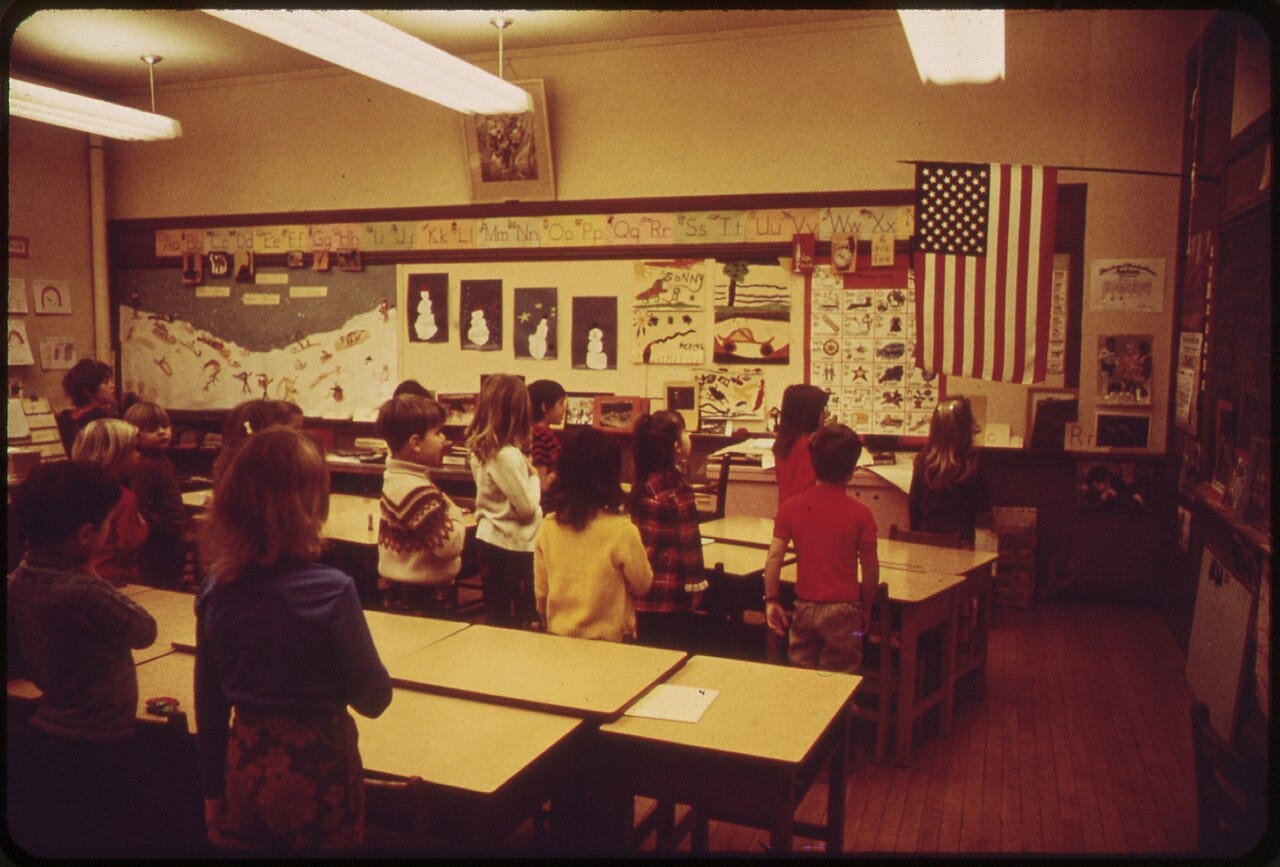
It’s often said, or at least hoped, that every generation has it easier than the last.
I’m no exception.
My mom’s dad grew up on a farm where his family raised all their own food and from where he and his siblings walked a mile to church and school in shoes riddled with holes. My mom’s mom helped raise her seven younger siblings and tend the house, milking the goats every morning, hanging clothes on the line, ironing, mowing the grass and doing the dishes.
Both of my dad’s parents were raised in single-parent households. After my grandpa’s dad died, his mom raised him, along with his seven siblings, in a chicken coop. My grandma learned how to take care of herself at a young age, her mother having died when she was three and her father frequently gone.
My dad began working at age 9 at the family Dairy Freeze and continued to work in whatever the family business was at the time — a pool hall, roller rink or a rotating assortment of bowling alleys — bringing home all his earnings. With money always tight, hunting was a way to keep protein on the table and was done both in and out of season, with or without a permit.
My mom and her four siblings grew up shoveling the driveway, cutting the grass, cleaning the house, doing the dishes and paying for most things themselves, including clothes and extracurriculars. Her family ate out just one dinner a month – at McDonald’s – and every day they were expected to bring home their brown paper lunch bag to use for the next day’s lunch.
The problem with freedom

Why some are so quick to give up the freedom that Americans like Margaret Corbin gave so much for.
Frederick Douglass once said, “If there is no struggle there is no progress.”
His struggle, however, looked much different than those of my grandparents or parents.
Few people embody the idea of America more than the man who though born into slavery in 1818 had escaped it 20 years later. But his escape wasn’t his most notable achievement, rather his transformation from a person who had endured great personal injustice to someone who gave his life in service to the nation that had so long allowed it.
Douglass taught himself to read, write and orate, and ultimately founded and operated a newspaper, published three autobiographies, fought for the abolition of slavery, advocated for women’s suffrage, served as president of Freedman’s Savings Bank and was appointed the first black man to serve as U.S. Marshal for the District of Columbia – among many other things.
He knew better than most that the path to improvement is littered with struggles. Douglass didn’t go in search of hardship or exaggerate it, rather when it showed up at his door, he faced it with dignity and humility.
Douglass’ association between struggle and progress was expressed in a much larger context. It was part of his speech, delivered in New York in 1857, commemorating the anniversary of the abolition of slavery in the British West Indies.
"If there is no struggle there is no progress,” he said. “Those who profess to favor freedom and yet depreciate agitation, are men who want crops without plowing up the ground. They want rain without thunder and lightning.”
Man’s folly, Douglass believed, was in how he took up his task, how he accepted the work before him — no matter how large or small.
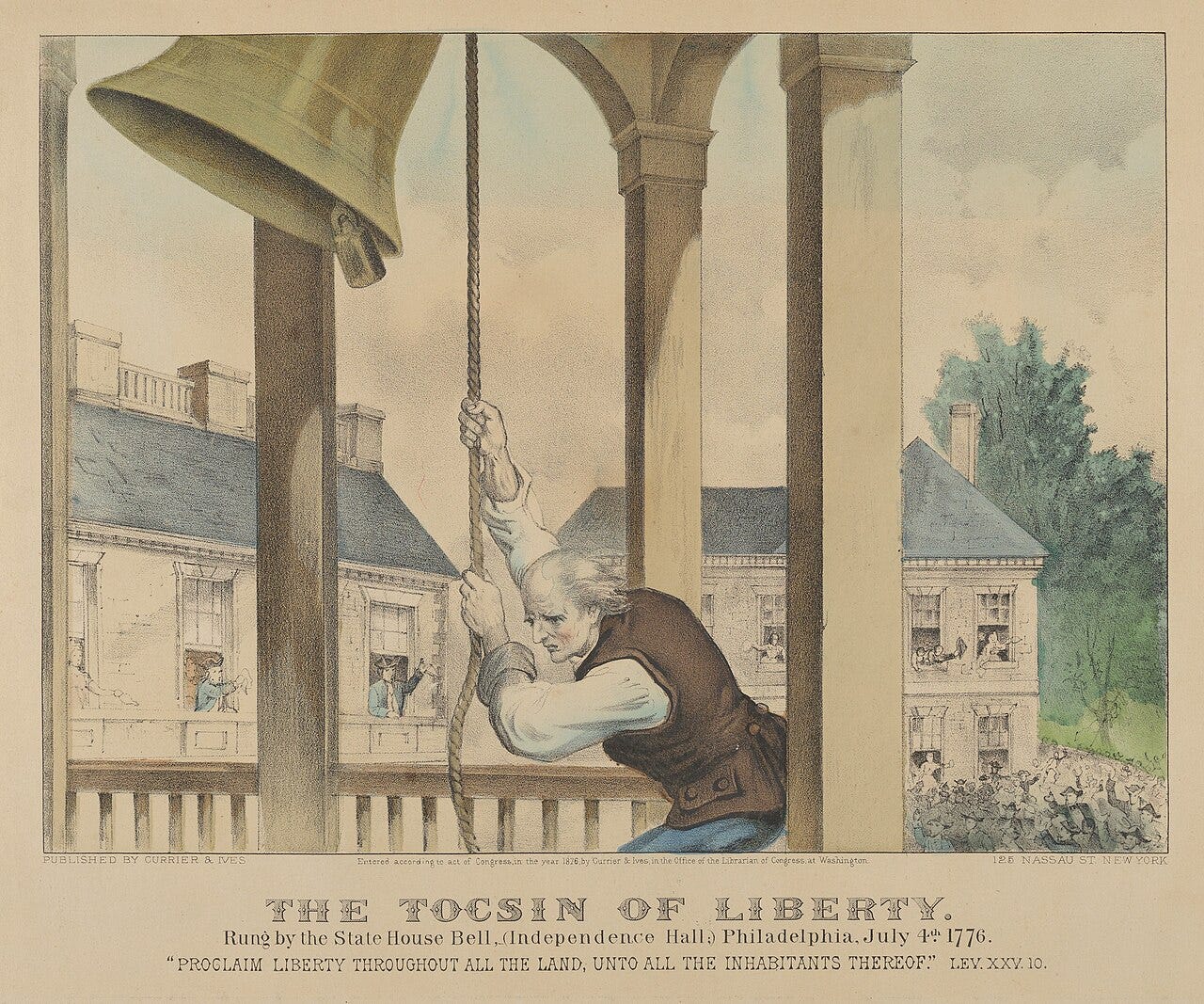
When the founding fathers drafted and signed the Declaration of Independence, 250 years ago, they knew it wouldn’t be easy.
To Britain, it was a declaration of war, and the odds were not in America’s favor.
Great Britain boasted the world’s premier navy, a disciplined army and vast financial resources. The founding fathers knew that freedom would come at a cost. But they also had nothing to lose.
The colonists lived under the tyrannical leadership of an absent king and his 558-member Parliament a month’s journey away, where they had no representation. Governed by a corrupt legal system, forced to house and feed British soldiers, restricted in trade and westward expansion – while living a demanding, exhausting and precarious existence – the founding fathers and the colonists they represented thought they could do a better job. Or at the very least, that they had the God-given right to try.

I’ve often wondered if my generation and younger ones have had it too easy —
if the general lack of hardship has caused us to not appreciate the struggles and sacrifices of those who came before us. For the longest time, I thought my lack of tribulations somehow made me less American — or at least less worthy of the title.
But a careful retrospective reveals generations following in Douglass’ footsteps — doing what they could to make life better, for themselves, their families, their communities and their country. They accepted the circumstances of their lives while not becoming complacent with them, knowing what lay on the other side of struggle.
This is something that’s characterized America since her founding.
As Alexis de Tocqueville put it in 1835, having toured the country, “The first thing which strikes a traveler in the United States is the innumerable multitude of those who seek to throw off their original condition.”
I may, at times, under-appreciate the sacrifices made by preceding generations and take my freedoms for granted. But in my 40 years as an American, I’ve never once thought I was done improving, or that our country was.
My life is easier because the founders wished and worked for it to be so. I owe it to them to not forget it — and to not let my children forget it either.
So like the generations before me, we’ll continue those practices which make us American: raising and saluting the flag, reciting the pledge of allegiance, singing the national anthem, attending backyard barbecues on Memorial Day, shooting off fireworks every Independence Day.
Recognizing America as an idea worth celebrating.

In a letter to his wife Abigail, dated July 3, 1776, John Adams described the historic moment the nation found itself in.
The day before, the Continental Congress had voted to approve the resolution for independence and would move to adopt the Declaration of Independence the next day — what Adams said would be “the most memorable Epocha in the History of America”:
“I am apt to believe that it will be celebrated, by succeeding Generations, as the great anniversary Festival. It ought to be commemorated, as the Day of Deliverance by solemn Acts of Devotion to God Almighty. It ought to be solemnized with Pomp and Parade, with Shews, Games, Sports, Guns, Bells, Bonfires and Illuminations from one End of this Continent to the other from this Time forward forever more.
“You will think me transported with Enthusiasm but I am not. I am well aware of the Toil and Blood and Treasure, that it will cost Us to maintain this Declaration, and support and defend these States,” he continued. “Yet through all the Gloom I can see the Rays of ravishing Light and Glory. I can see that the End is more than worth all the Means.”
I’d love to know what you think in the comments. What does being American mean to you? Are we at risk of losing that?

Every generation has their own struggles, both personal and national. Mine looked pretty awful at times, but to live, especially in America, is to have the opportunity to try to better one’s situation and to thrive. Having lived in other countries, I know first hand how fortunate we are to have such incredible men and women as our forebearers.