The rationalization of beauty
When we assign beauty a purpose, do we begin to lose ours?

“Beauty is vanishing from our world because we live as though it did not matter.”
— Sir Roger Scruton
Long before cherry blossoms became a staple of Japanese culture, there were plum blossoms.
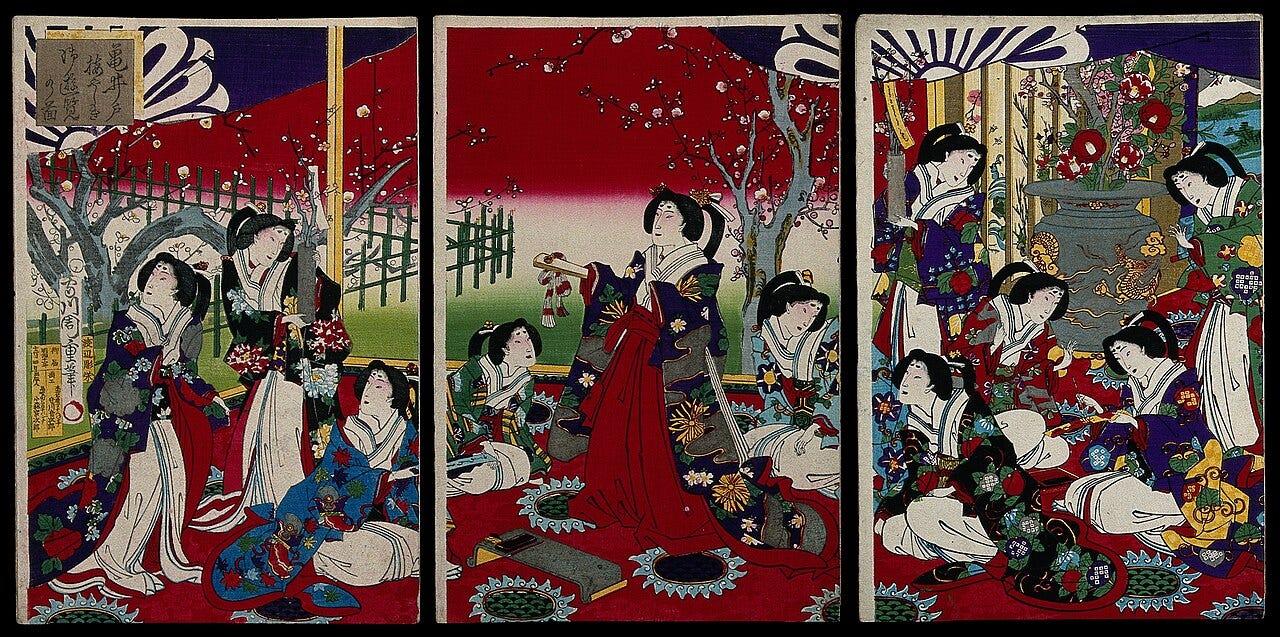
In late February, snow still blanketing the landscape, Japanese elites — nobles, government officials, scholars, Buddhist clergy and members of the imperial family — would gather together to admire and celebrate the blooming of the prunus mume, or plum blossom trees.
This practice, known as umemi, got its start in the 7th century following the import of these trees from China, where they were a symbol of resilience and refinement. But these late winter blooms took on even greater significance in Japanese culture.
To the Japanese, plum blossoms represented endurance, renewal and quiet strength. Elites would come together to not just observe the ume, or plum blossom, but to write and recite poetry and music about it. Poems from the 8th century describe its fragrance as well as the symbolism of its late winter bloom – the shift from hardship to hope.
From the umemi came the Japanese concept of mono no aware. Rooted in Buddhist principles, this aesthetic philosophy emphasizes the impermanence of beauty. Rather than seeing this as a sorrowful thing, the Japanese’s awareness that beauty is fleeting led to greater appreciation for it.
Cherry blossoms, which drop within days of blooming, came to encapsulate this philosophy even more and expanded the practice to the masses. People of all backgrounds and classes would come together once a year to admire and contemplate the beauty and transience of the cherry blossom.
Shared aesthetic experiences
For as long as humans and nature have coexisted people have been structuring their lives around the natural world, with rituals and practices focused on its beauty and rhythms. These shared aesthetic experiences provided stability and connection in an otherwise volatile world.
Natural beauty is one of the few things — particularly in today’s divided world — that enjoys such consensus.
“I can’t think of anyone who doesn’t think a sunset is beautiful or a mountain range is beautiful. Humans have a lot of agreement on beauty in nature,” says Dr. Margarita Mooney Clayton, founder of the Scala Foundation, an organization committed to transforming culture through beauty, creativity and joy.
The evidence for this unanimity is not just anecdotal.

Dr. Oshin Vartanian is an associate professor in the Department of Psychology at the University of Toronto studying neuroaesthetics (i.e., how the brain processes and develops preferences for objects). He says experiences with beauty of all kinds — as well as flavors — have been shown to activate a common set of regions in the brain associated with reward.
“The underlying idea is that as humans have evolved and generated preferences for all sorts of things … the underlying system in the brain involved in forming those preferences has remained the same,” says Vartanian. This, he adds, points to a shared taste for “natural aesthetic domains” over man-made objects.
“There is a lot more consistency in what people tend to [prefer] when they’re looking at things from nature versus things that are human made. When people look at faces and natural scenes, there are more likely to be similarities in what they like. When you look at things that are human made – for example, architecture or artworks – you see a lot more individual differences in comparison.”
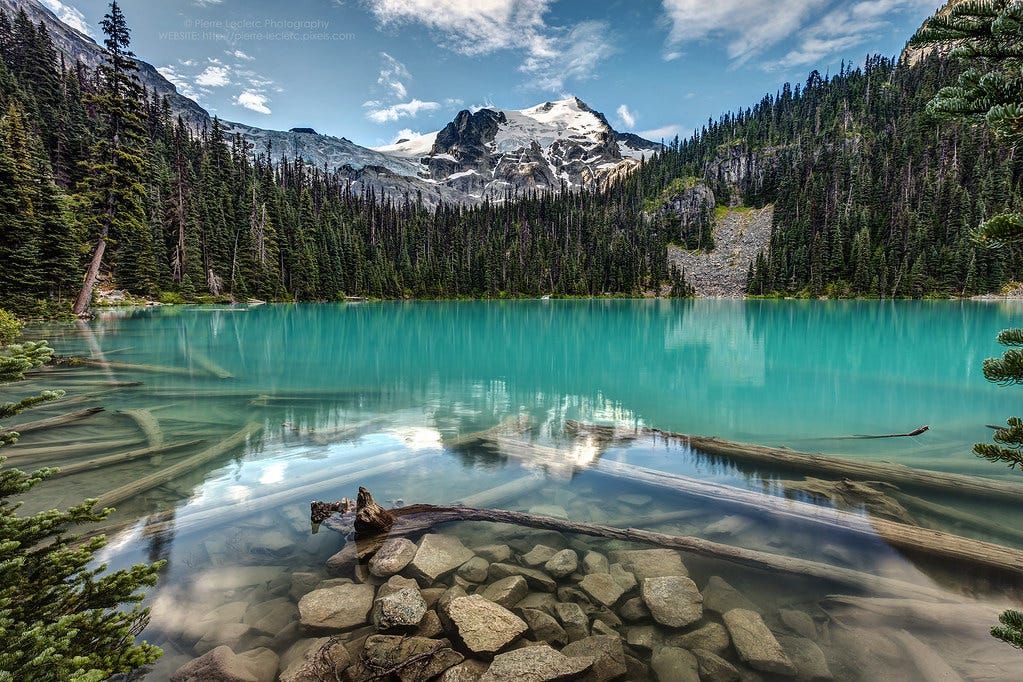
Our response to beauty, then, is much like that of fear or any other emotion we experience for that matter. When we feel fearful or threatened, our innate response is to flee or fight. So, what about when we see something beautiful – an alpine landscape, for instance?
According to Clayton, our natural response is awe — what she describes as “the beginning of curiosity.”
“We’re meant to approach the world with open eyes and open hearts, to see all that is there, and awe and beauty remind us that as human beings we are limited,” she says. “When we find something awesome and beautiful, we know something for certain, but … we also see that it points to something beyond itself that’s greater.”
Clayton sees this as a higher power.
“I understand beauty as God’s goodness radiating throughout the world; it’s a material expression of goodness in the world,” she says. “How do we know there’s goodness? Because we have beauty. But at the same time, beauty never fully satisfies us.”
Beauty therefore sparks in us the need to explore, to seek understanding. The restlessness it creates begs the question, what’s it all for?
It’s a question that even science can’t discount.
“[My view is that] when you look at a particular object you find beautiful, it resonates with you because it’s providing some kind of a signal to your brain that what you’re looking at is important or relevant for a reason,” Vartanian says. “In this sense, it’s clearly related to meaning. The fact that you’ve had this experience that you define as beautiful typically means there’s something more there to consider and that, for me, has a connection to meaning.”
Agreement over natural beauty has translated to human creations as well. When we create art or buildings, we’ve historically done so with this shared understanding of what’s beautiful.
“If we can agree that an open sky and a sunset are beautiful, wouldn’t we be able to subtract meaning from that — look at the patterns of nature and create objects in the world which replicate or imitate those in new ways?” Clayton says. That historically has been what was understood as creating something beautiful – observing nature and replicating its patterns.”
But that begs the question: What are we to make of modern art — which seems at times in direct opposition to the principles and patterns of nature?

Beauty as an ultimate value
On a recent Tuesday, I made a pilgrimage to my local art museum – the St. Louis Art Museum – a place I’ve been tens if not hundreds of times. Feeling uninspired, I was seeking a connection to something real.
There’s one painting I always gravitate toward that I knew would meet my need: Joseph Wright of Derby’s painting of a moonlit river. In it, a lone manned vessel sits at the river’s bend, illuminated by the moon and dwarfed by pines and a crumbling manmade structure that are silhouetted against the moonlit landscape. The serenity of the scene, the juxtaposition of the light and dark, the man-made world and the natural world, captivates me every time.
Eventually I walked on, turning left into a large room, vacant but for one piece on a round white platform in its center. My instant reaction was one of confusion. The artwork, if one can call it that, was made up of shiny metal rods angled in different directions, compressed cardboard shapes that have the look of having melted – like something out of Alice’s Wonderland – and bone-shaped fragments from which fabric fingers protrude.
It seemed less like something copied from nature and more like the product of a bad acid trip. My confusion was replaced by a feeling not of awe, but disgust.
Turns out, there’s a reason for it.

“Too often when people go from the natural order, the environment, to what humans create, there’s almost a sense that instead of just creating something we can all agree is beautiful, we have to make sure we create things that are so unique that they’re transgressive or edgy,” says Clayton, noting that the same is often true of modern architecture.
This focus on creating unconventional and subversive works may have something to do with our obsession with utility.
In the modern industrialized world, we have a habit of believing everything must have some practical function. Every human creation serves some need, therefore art must have some utility, too, right? Whether that purpose is to shed light on the injustices of the world, offer commentary on our capitalistic tendencies or represent the chaos of our modern lives is up to each independent creator.
Late British philosopher and writer Roger Scruton, however, argued against this idea. He believed beauty serves no purpose but its own.
“Beauty is an ultimate value — something that we pursue for its own sake, and for the pursuit of which no further reason need be given,” he said. “Beauty should therefore be compared to truth and goodness, one member of a trio of ultimate values which justify our rational inclinations.”
Perhaps it’s because of this focus on function that we appear to be losing our connection to beauty. As Clayton explains it, we are increasingly becoming a society that favors ideology over mystery.
“Human beings are drawn to certainty, but whatever certainty we have always points to something beyond itself — that’s what I call mystery,” she says. “Ideology is when we break that process of questioning and settle for just one frame or one perspective; that closes down the questioning and ends the quest.”
Unlike the Japanese, who continue to live by mono no aware, much of the western world no longer shares a common understanding of what is worthy of reverence in the first place.
Still, I find hope in knowing that somewhere, someone else is watching the same sunset and feeling the same quiet ache — the combination of sorrow, gratitude and awe that comes from the awareness of the transience of it all.