‘A great fire in our soul’: The tragic irony of Vincent van Gogh
How a man with so much to give neglected his gift until it was nearly too late.

“Try to grasp the essence of what the great artists, the serious masters, say in their masterpieces, and you will again find God in them. One man has written or said it in a book, another in a painting.”
—Vincent van Gogh
In December of 1878, a young Vincent van Gogh arrived on the streets of the Borinage region of Belgium. He wasn’t there to paint or sketch, nor was he there to study.
He had come to preach the gospel to coal miners.
By the age of 25, Vincent had tried a few professions, including teacher, art dealer and bookseller; he thirsted for purpose and meaning, yet none of these paths had provided. While he enjoyed art, he seemed to view it merely as a pastime, not a serious vocation.
The son and grandson of Protestant ministers, Vincent was deeply religious, with a deep desire to serve humanity. But his attempt to become an ordained minister was also unsuccessful. He failed his entrance exams at the Flemish Training School in Brussels – a school for aspiring missionaries – and, in November of 1878, the administration informed him he would not receive funding.
In a letter to his brother Theo, dated November 15, 1878, Vincent wrote:
“I spoke with the Rev, de Jong and Master Bokma, they tell me that I cannot attend the school on the same conditions as they allow to the native Flemish pupils; I can follow the lessons free of charge if necessary – but this is the only privilege – so in order to stay here longer I ought to have more financial means than I have at my disposal, for they are nil.”
Bringing light to those in darkness
Reading Vincent’s many letters to Theo, a picture emerges of a young man adrift in the world, desperately searching for purpose and a way to help those in need.
His affinity for the working class and the downtrodden was clear. Vincent would often observe laborers as they went about their work, sympathizing with them but also feeling a deep sense of respect for the dignity with which they accepted their toil.
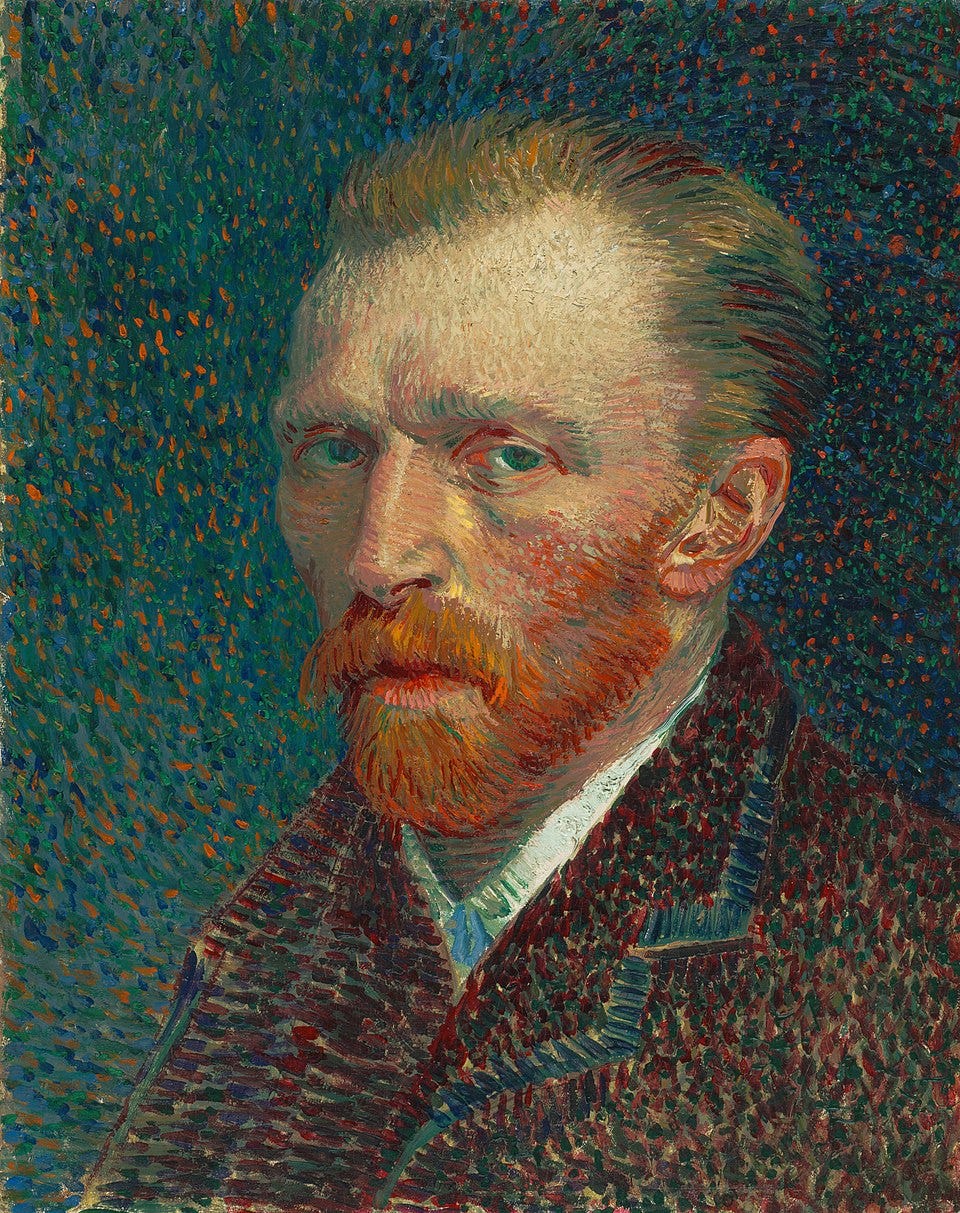
In a way, he seemed envious of their sense of duty and purpose. And as in everything, he saw God in their struggle. In his November letter to Theo, Vincent recalled observing the street cleaners and their carts one evening and, as was so often the case, how it called to mind some work of art:
“They seemed sunk and rooted still deeper in poverty than that long row, or rather group of paupers, that Master de Groux has drawn in his ‘Bench of the Poor.’ It always strikes me, and it is very peculiar, that when we see the image of indescribable and unutterable desolation – of loneliness, of poverty and misery, the end of all things, or their extreme, then rises in our mind the thought of God.”
His love of God is evidenced by his letters, as is his passion for art. The two were often interwoven in his mind. In one letter to Theo, he wrote: “I think that everything that is really good and beautiful, the inner, moral, spiritual and sublime beauty in men and their works, comes from God.”
But despite his obvious adoration for and inclination toward art, he continued to keep it at a distance.
That November, after being denied entry into missionary school – the latest in a long line of failures – and facing some undefined crossroad, Vincent took to the streets of Brussels. There among the working class, he was reminded of why and whom he wanted to serve.
“When we had taken leave I walked back, not along the shortest way but along the tow-path,” he wrote to Theo. “Here are workshops of all kinds that look picturesque, especially in the evening with the lights, and to us who are also labourers and workmen, each in his sphere and in the work to which he is called, they speak in their own way, if we only listen to them, for they say: Work while it is day, the night cometh when no man can work.”
Vincent couldn’t escape the feeling that there was greater work to which he was called. He decided that if he wasn’t suited for a conventional job or allowed to serve in an official religious capacity, he could contribute in another way — as a lay preacher to those whom he believed needed God the most.
“You know how one of the roots or foundations, not only of the Gospel, but of the whole Bible is, ‘Light that rises in the darkness,’ from darkness to light. Well, who will need this most, who will be open to it? Experience has taught that those who walk in the darkness, in the centre of the earth, like the miners in the black coal mines for instance, are very much impressed by the words of the Gospel, and believe it too.”


Thus in January of 1879, Vincent began preaching the gospel in the southern coal-mining region of Belgium called Borinage, having been granted a six-month position as a preacher for the Belgian Evangelization Committee.
He committed himself fully to his work, not only preaching about the life of Jesus but living it. Vincent regularly accompanied miners into the mines, visited and helped care for the sick and injured, and eventually gave up his clothes and possessions – even his bed – to live as the miners did.
Despite the desolate conditions in which he lived, he remained fascinated by and passionate about his work and the region and its people, who despite their struggles seemed content. In a letter to Theo, he wrote:
“The country and the inhabitants charm me more every day. One has a homelike feeling here, like on the heath or in the dunes; the people have something simple and good. Those who leave are homesick for their country; on the other hand, homesick foreigners lose their nostalgia for their own country and adapt easily.”
Vincent continued to see the beauty in the harsh reality of the world around him. His letters are full of passages about art, the “picturesque” landscape and the people who worked its depths, as well as his occasional attempts to capture through sketches the raw magnetism of the region and its inhabitants.
A lesson in suffering

How Viktor Frankl and other Holocaust survivors found meaning in the face of immense suffering.
“The miners returning home in the evening towards dusk in the white snow were a singular sight. These people are quite black when they emerge into the daylight from the dark mines, looking just like chimney sweeps. Their dwellings are usually small and should really be called huts; they lie scattered along the sunken roads, in the woods and on the slopes of the hills. Here and there one can still see moss-covered roofs, and in the evening a friendly light shines through the small-paned windows.”
But Vincent’s contentment would not last.
At the end of the six months, the Belgian Evangelization Committee commended Vincent’s devotion to the sick and injured but criticized his extreme self-sacrifice for “undermining the dignity of the priesthood.” They would not be extending his service, they informed him, and gave him three months to move on.
By the next month, Vincent had left. For nearly a year he wandered, returning home to the Netherlands for some time, after which he traveled around staying with different people. During that time, he and Theo stopped writing.
A longing for action
Who has ever felt the pull to give something back to the world, both the desire and duty to contribute? The person who knows he has so much to give but doesn’t know how or what — the weight of this paradox rendering him paralyzed.
As it’s been for many others, this was Vincent’s condition.
In what was the first letter to his brother following his dismissal from his preaching position, Vincent wrote:
“For there is a great difference between one idler and another idler. There is someone who is an idler out of laziness and lack of character, owing to the baseness of his nature. If you like, you may take me for one of those. Then there is the other kind of idler, the idler despite himself, who is inwardly consumed by a great longing for action who does nothing because his hands are tied, because he is, so to speak, imprisoned somewhere, because he lacks what he needs to be productive, because disastrous circumstances have brought him forcibly to this end. Such a one does not always know what he can do, but he nevertheless instinctively feels, I am good for something! My existence is not without reason! I know that I could be quite a different person! How can I be of use, how can I be of service? There is something inside me, but what can it be? He is quite another idler. If you like, you may take me for one of those.”
Vincent made clear that he was the latter — that despite his defeats, he wasn’t giving up.
“Instead of giving in to despair I chose active melancholy, in so far as I was capable of activity. In other words I chose the kind of melancholy that hopes, that strives and that seeks, in preference to the melancholy that despairs numbly and in distress.”
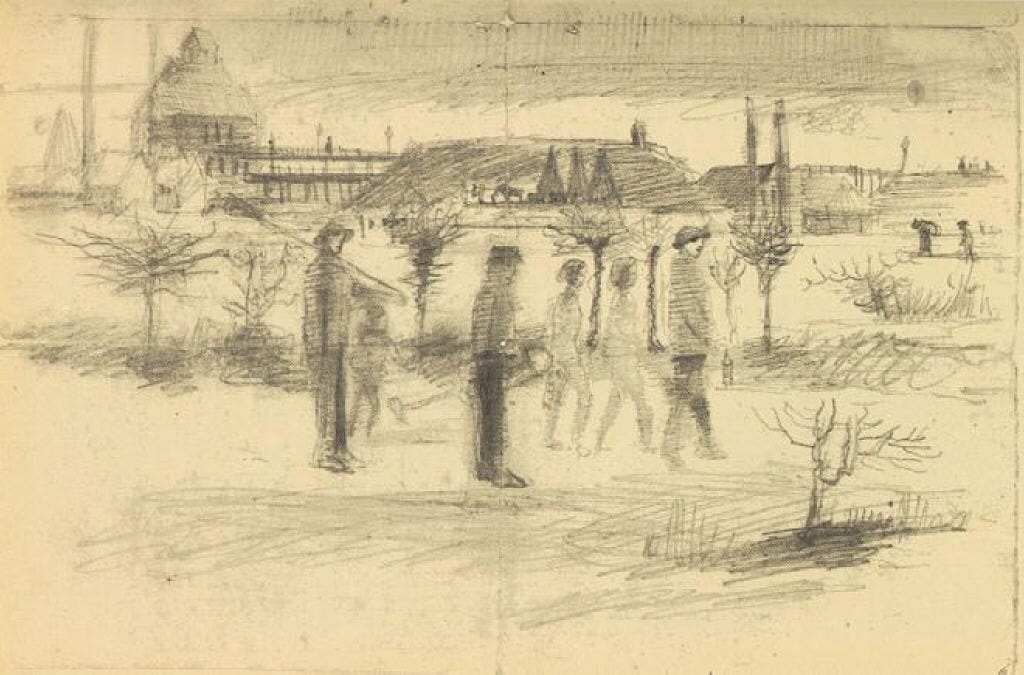
Vincent’s letter conveys the sense that perhaps art was the last and only thing that could make his existence bearable and meaningful. And he alludes to his decision to finally commit himself to it.
His next letter, dated August 20, 1880, was filled almost entirely with talk of his art and accompanied by a sketch of some miners (see above).
Vincent continued to throw himself into his work, studying the great masters he spoke of and, over the next decade, producing over 2,000 works of art. But even his dedication and skill could not save him.
Vincent was focused on emotion and distortion in a world seeking technical precision. A post-impressionist in an era of realists. Also lacking the social and commercial savvy necessary to sell his art, Vincent continued to be plagued by self-doubt, which contributed to his mental struggles and, many believe, his death.
“Can you tell what goes on within by looking at what happens without? There may be a great fire in our soul, but no one ever comes to warm himself by it, all that passers-by can see is a little smoke coming out of the chimney, and they walk on,” Vincent wrote to Theo in July of 1880. “All right, then, what is to be done, should one tend that inward fire, turn to oneself for strength, wait patiently – yet with how much impatience! – wait, I say, for the moment when someone who wants to come and sits down beside one’s fire and perhaps stays on? Let him who believes in God await the moment that will sooner or later arrive.”
For Vincent, this moment arrived too late.
He didn’t live to see his own success. But today there is not a person who doesn’t know his name or who hasn’t seen his work. Yet not everyone knows his full story – one defined by passion and conflict, beauty and pain, a commitment to God and humanity.
Vincent’s life is proof that we can find meaning not in spite of but sometimes because of our suffering. He may have never overcame his own struggles, but what he did do was more impressive: He chose to act — to create — in the face of it.
Thanks for reading! If you enjoyed this article, please subscribe, comment and share with others. If you believe in the importance of thoughtful, nuanced writing and independent journalism, I hope you’ll consider becoming a paid subscriber to help support the time and energy that goes into producing these stories.
“Someone who has been wandering about for a long time, tossed to and fro on a stormy sea, will in the end reach his destination.”
—Vincent van Gogh