“The only true wisdom is in knowing you know nothing.”
—Socrates
At the age of 16, I suddenly became overwhelmed by a desire to know all things and be all things. To be the ideal, perfectly well-rounded person.
My passions, interests and desire to be a good person pulled me in every direction. The realization that there were so many things I didn’t know, that would take me years to learn — things that I may never know — overpowered me, and for a time, I was depressed.
My desire for knowledge had pulled me in one direction, but it could have just as easily pushed me in another. To a place where knowledge is absolute, where it digs in its heels and says I’ve seen enough. That is the place where knowledge stops and arrogance and ignorance begin.
One night a few years ago, as my family sat down to dinner, my daughter — then 3 years old — turned to me and my husband and, in her small voice, said, “Mommy, Daddy, are there things I don't know?” Shaking off our astonishment, we told her the truth — that of course there were things she didn’t know, that there were many things that we still didn’t know, even as adults — and that that’s OK. Learning, we told her, is a lifelong process and realizing that you don’t know everything, or even most things, is the most important knowledge a person can have.
As William Shakespeare once wrote — in his play Henry VI (part 2):
“Ignorance is the curse of God, knowledge is the wing wherewith we fly to heaven.”
For the curious, knowledge begets more knowledge. To the indifferent or dogmatic, it becomes hazardous — a weapon to be wielded as you please. As English novelist Samuel Butler once wrote: “A little knowledge is a dangerous thing, but a little want of knowledge is also a dangerous thing.”
To assume that our current treasury of knowledge is complete — or perfect — is flawed (just consider the practice of bloodletting). Rather, we should always be seeking and questioning. As notable management consultant and author Peter Drucker said, “Knowledge has to be improved, challenged and increased constantly, or it vanishes.”
For the great thinkers Copernicus and Galileo, this meant facing off against the very orthodoxy that sought to limit the pursuit of knowledge.
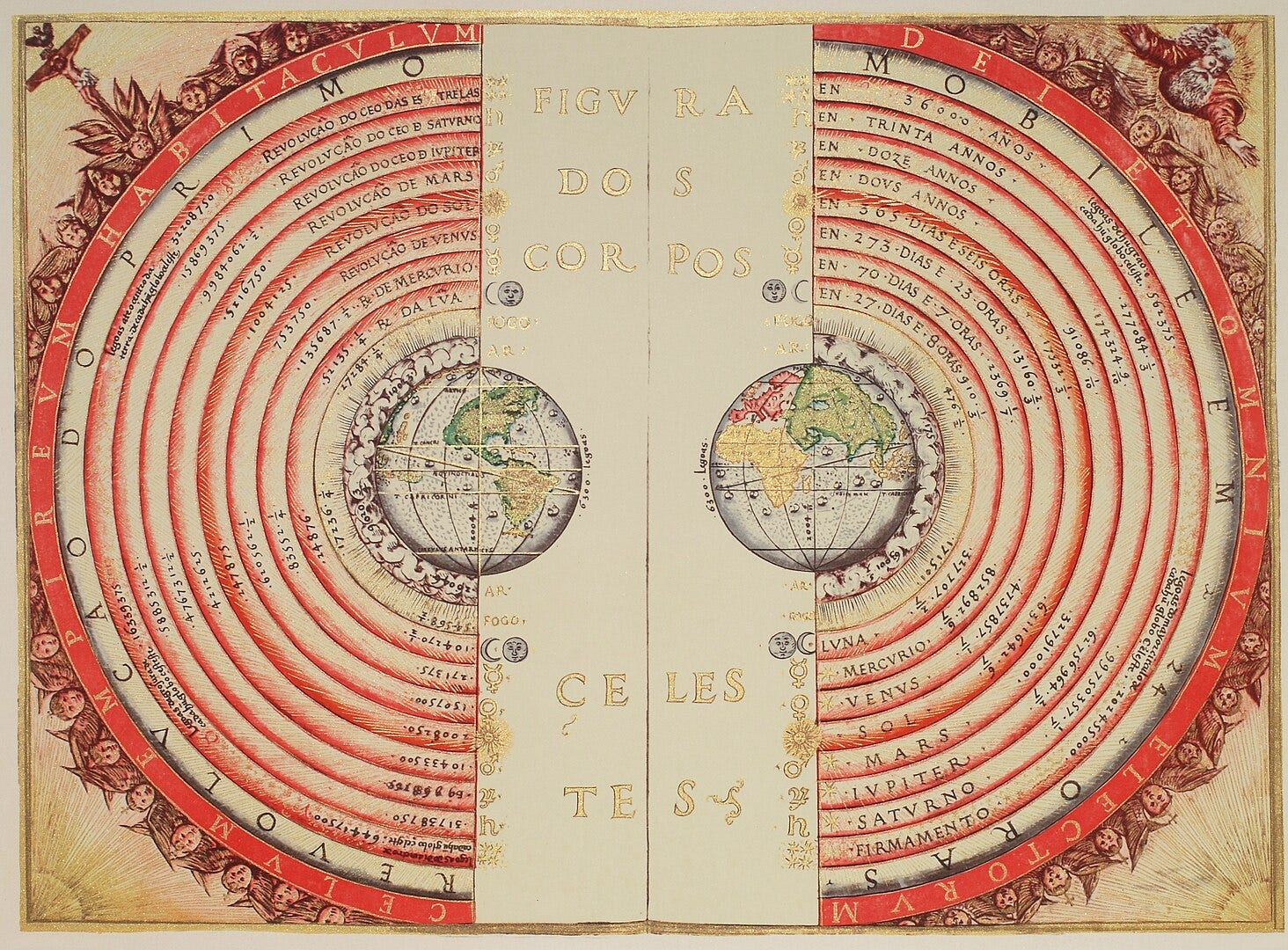
Up until the 16th and 17th centuries, people believed in the geocentric model of the universe
— the idea that the Earth is at its center and that the sun and planets revolve around it. First put forth by Greek astronomer and mathematician Eudoxus around 380 BCE, the model was further refined by the Greek philosopher Aristotle and, later, the Roman mathematician and astronomer Ptolemy. Despite its complexity, the geocentric model remained the prevailing view of the universe for nearly 1,500 years.
And it’s easy to see why.
As Daisy Dobrijevic writes for Space.com, “When gazing up at the night sky from what feels like a fixed reference point and witnessing the stars and planets dance across the sky, we can understand why the ancient Greeks adopted the geocentric view of the universe. … Most of the time the model worked. It could explain why stars appear to rotate around Earth once per day and why planets move differently to stars.”
The model also aligned with religious beliefs of that time in which the gods created man and thus man must be at the center of the universe. But as people have continued to study the skies so, too, have we continued to advance technologically and scientifically.

By the time the astronomer and mathematician Copernicus entered the picture in the early 1500s, the geocentric model had long been the accepted version of the solar system, by the Catholic Church and others. Copernicus, however, challenged this model, proposing instead a simplified version of the solar system. One in which the sun – like a life source – sits at the center, while the Earth and all other planets revolve around it. Understanding the turmoil that his heliocentric model would cause among both the scientific and religious communities, Copernicus held off on publishing his theory until the year of his death, in 1543.
It wasn’t until decades later, when Galileo came along, that the idea that humans weren’t the center of the universe began to be more widely explored and considered. In 1610, Galileo made two discoveries that supported the heliocentric view of the solar system: moons orbiting Jupiter, which proved “objects could orbit objects other than Earth,” Dobrijevic writes. “Secondly, he discovered that — like the moon — Venus had phases, which further confirmed the theory that Venus (and the other planets in the solar system) orbit the sun.”
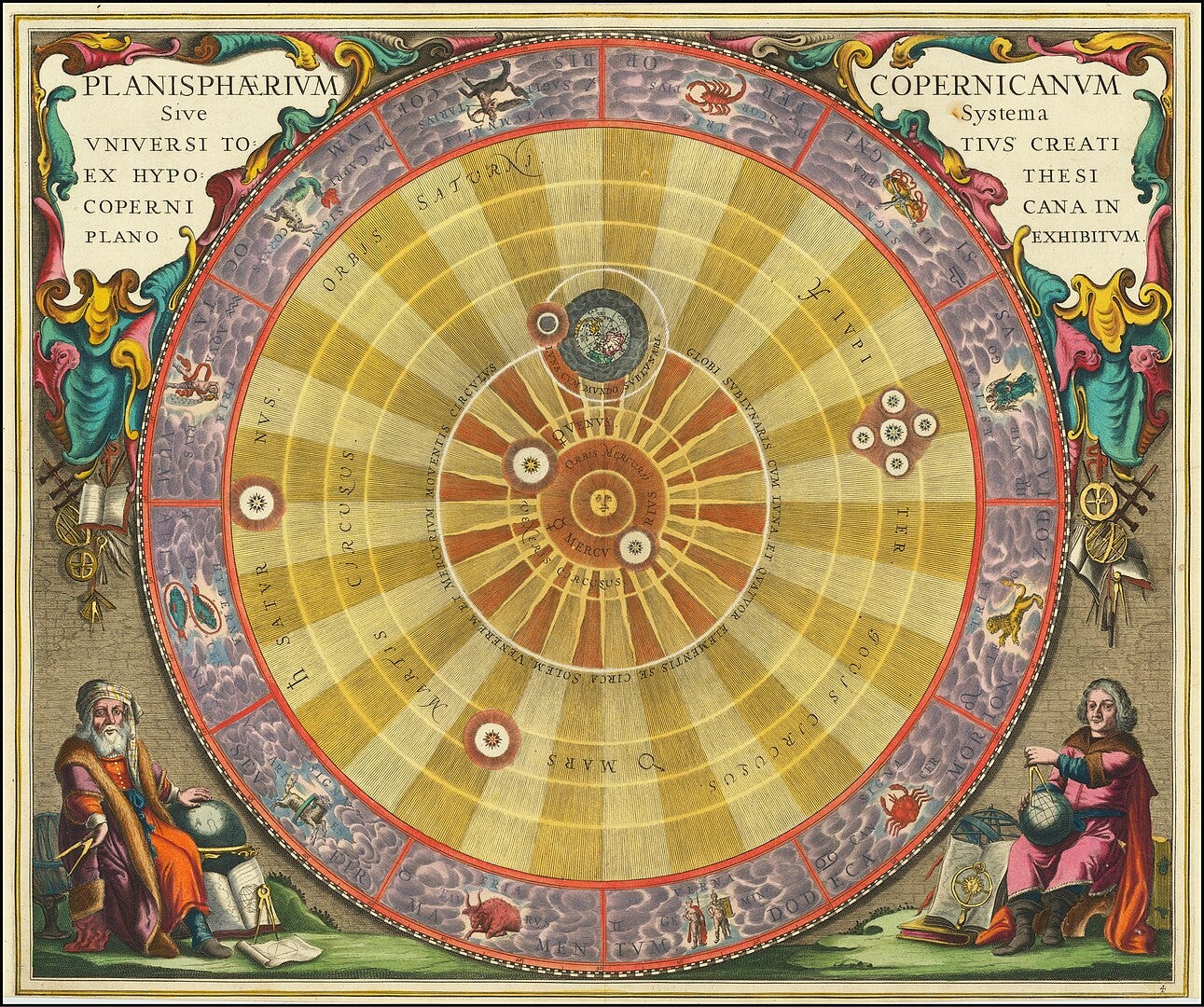
The concept of a heliocentric universe still highly controversial, Galileo’s theory was labeled heresy by the Catholic Church.
“Following his own observations and the findings by other astronomers, no one could really argue anymore that what one saw through the telescope was an optical illusion, and not a faithful reproduction of the world,” Mario Livio, author of the book Galileo and the Science Deniers, writes for History.com. “The only defense remaining to those refusing to accept the conclusions first proposed by Nicolaus Copernicus … and bolstered by accumulating facts and scientific reasoning, was to reject the interpretation of the results.”
The Church argued that the heliocentric model Galileo pushed conflicted with scripture as well as the geocentric model that was a central part of Catholic orthodoxy. Despite this, Galileo published his findings in his book, Dialogue Concerning the Two Chief World Systems — a move that led the Catholic Church to launch an inquisition into the man now considered “the father of modern science.”
Following a three-part trial, in 1633, the Church concluded that Galileo had violated the church’s prohibition on holding, teaching or defending the Copernican view of the universe. For this, Galileo was forced to renounce Copernicanism and to recant much of his life’s work.
It would be more than a century till the heliocentric model first proposed by Copernicus and later refined by Galileo would become widely accepted — mounting evidence eventually making it impossible for both scientists and the Church to reject. Today, it remains the prevailing view, contributing to our growing understanding of the universe and our place in it — but only because there were those who dared to question and look beyond current knowledge, who were committed to seeking truth.
This post contains affiliate links. We earn a small commission from books purchased through these links.
“Anyone who challenges the prevailing orthodoxy finds himself silenced with surprising effectiveness. A genuinely unfashionable opinion is almost never given a fair hearing, either in the popular press or in the high-brow periodicals.”
— George Orwell