The uncomfortable truth about the First Amendment
From flag burning to Nazi marches, even the most offensive speech has its place.

“We know that no one ever seizes power with the intention of relinquishing it.”
— George Orwell, “Nineteen Eighty-Four”
In 2001, following the 9/11 terrorist attacks, the U.S. Federal Aviation Administration, with data from the FBI, created a list of approximately 16 individuals who were considered too dangerous to travel by plane. This “No-Fly List,” as it was dubbed, was created as a security precaution to keep suspected terrorists from boarding commercial aircraft.
The list was designed to protect air passengers and provide Americans with a sense of security during a time of heightened anxiety around air travel in particular. Yet, this tool still exists today — but with a much wider scope.
Following the creation of the Transportation Security Administration (TSA) in 2001 and the Department of Homeland Security (DHS) in 2003 — which are responsible for the application of the No-Fly List, using data from the FBI — the list was rapidly expanded. While the exact number of names on the current list is unknown — as DHS doesn’t release this information — leaked documents published by the Intercept showed 47,000 names as of August 2013, a number that included 800 Americans.
The problem with freedom

Why some are so quick to give up the freedom that Americans like Margaret Corbin gave so much for.
In his critique of the application of the No-Fly List, Director of Information Policy Studies at the Cato Institute Jim Harper stated, “It’s just entirely unconstitutional to have a direct executive branch punishment without the intermediary of a judge.”
The move, though controversial, was hardly without precedent.
This plot has played out before, both here and in other countries, in which governments have eroded civil liberties in the name of the greater good. Examples include the British Defense of the Realm Act (1914), Germany’s Enabling Act (1933) and the U.S. Patriot Act (2001), to name a few.
Same approach, different story.
Whether driven by fear or anger or some other emotion in reaction to some event, our government has been wont to restrict our civil liberties, in the name of safety and security. One could view their cause as just – even admirable – but as history has shown us time and time again, these measures are often not applied in a just and transparent manner and have a tendency to expand far beyond their initial timeline and scope. Perhaps most importantly, they create a slippery slope on which, with the swipe of a pen or the creation of a new department, the government can further erode our rights … for the purpose of the greater good.
Take President Trump, who last Monday signed an executive order that directs the Attorney General to prosecute individuals who desecrate the flag. While the order may ultimately carry little weight, its signing can be seen as a workaround to the protections previously afforded to flag burning.
As Newsweek’s Khaleda Rahman writes, “Though the order acknowledged the Supreme Court’s 1989 ruling that flag burning is protected under the First Amendment, it said there is room to prosecute if it ‘is likely to incite imminent lawless action’ or amounts to ‘fighting words.’” This type of speech, however, is already not protected under the First Amendment, per past Supreme Court decisions.
The discomfort of free speech
The desire to ban certain types of speech, however, is as old as the desire of a people to be free. And it’s understandable.
Certain speech is repulsive. It can make us angry, fearful, uncomfortable. But in a free country, as in the U.S., the burden is not on the speaker to adapt, but on the listener.
I may not like it when people burn the flag or don’t stand for the national anthem, or express hateful ideologies. I might think it repulsive, hypocritical, arrogant or performative. But, because I value my own right to speak my mind, I also value that of individuals with whom I disagree.
It’s for the free marketplace of ideas to decide which ones have merit. Not me, not you — and certainly not the government.
A lesson in suffering

How Viktor Frankl and other Holocaust survivors found meaning in the face of immense suffering.
Instead, we need a society that places more emphasis on sitting with discomfort — one that values individuals’ right to speak out without venerating their ideas.
Thankfully, the U.S. Supreme Court (SCOTUS) has defended the First Amendment time and time again, affirming the rights of those with even the most deplorable beliefs to express themselves, as in the case of the National Socialist Party of America v. Village of Skokie. For the Court understands that, as in the words of Harvey Silverglate, co-founder of the Foundation for Individual Rights and Expression (FIRE):
“It’s important to know who the Nazis in the room are so that I know not to turn my back on them.”
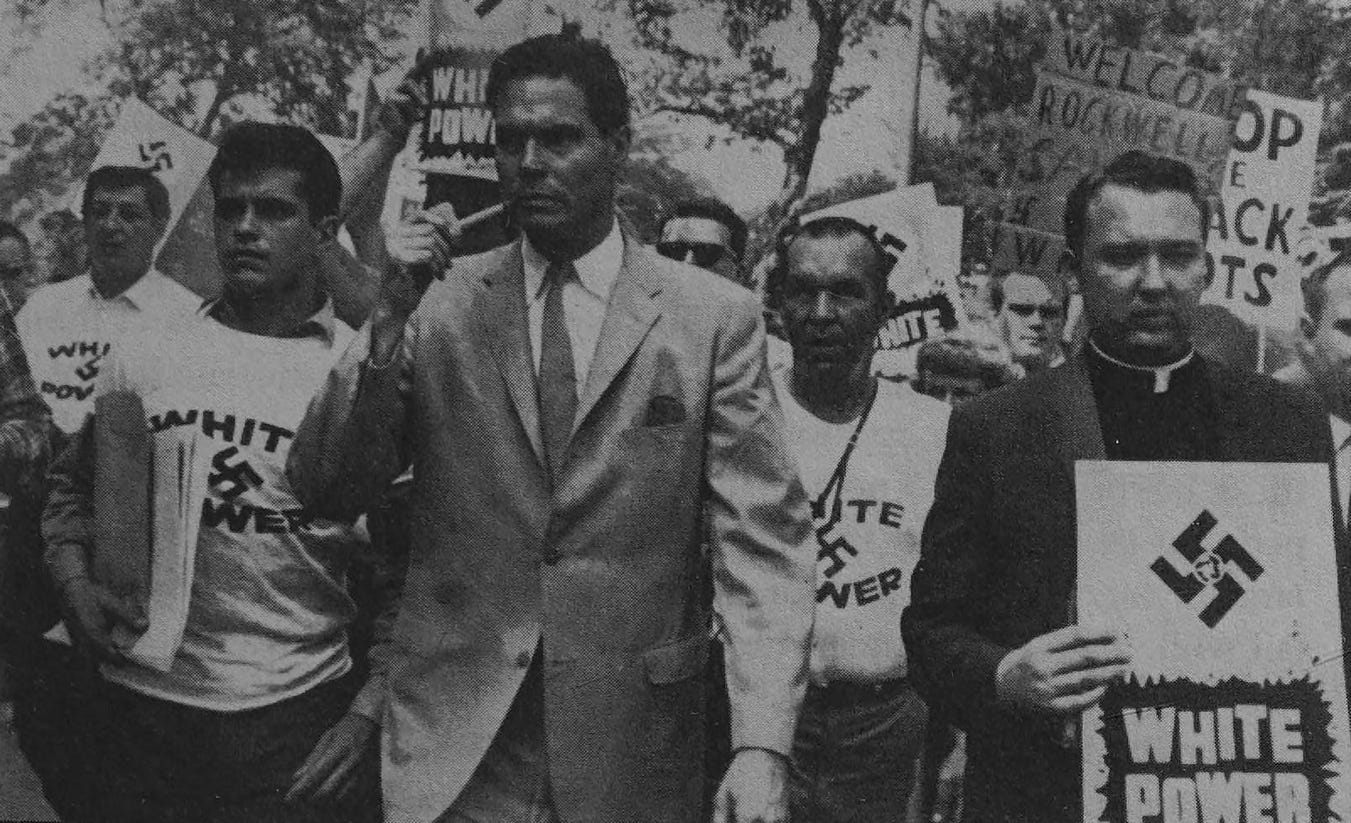
In spring of 1977, the neo-Nazi group the National Socialist Party of America planned a march through the northern Chicago suburb of Skokie, Illinois. Known for its large Jewish population, including many survivors of the Holocaust, residents were naturally alarmed and opposed the demonstration.
Skokie officials attempted to stop the march from taking place, securing a court injunction and passing ordinances requiring costly insurance bonds. They also banned Nazi uniforms and the distribution of materials with hateful rhetoric.
With the help of the ACLU, the Nazis challenged Skokie’s actions, claiming they violated their First Amendment rights. The case ultimately made its way to the Supreme Court, and in 1977, SCOTUS said that the Illinois courts had improperly delayed the group’s ability to appeal, amounting to “an unconstitutional prior restraint on free speech.” The Court emphasized that speech — even hateful speech — can’t be restrained without strict constitutional safeguards.
The case was remanded back to the Illinois Supreme Court, where Skokie attorneys argued that, for Holocaust survivors, seeing the swastika was akin to being physically attacked. The Court rejected this argument, stating in its ruling:
“We do not doubt that the sight of this symbol is abhorrent… Yet… this factor does not justify enjoining defendants’ speech. The display of the swastika… is a form of symbolic political speech protected by the First Amendment.”
Although SCOTUS didn’t decide outright whether Skokie could ban the march, its ruling set a precedent, establishing that even the most hateful, offensive speech cannot be censored simply because it’s abhorrent.
The ACLU, for its part, reportedly lost thousands of members for defending the rights of Nazis. The organization, however, understood the slippery slope that is the degradation of our civil liberties, acknowledging that if the First Amendment doesn’t apply to the worst speech, then it can be eroded for all speech.
This post contains affiliate links. We earn a small commission from books purchased through these links.
“If the freedom of speech is taken away, then dumb and silent we may be led, like sheep to the slaughter.”
— George Washington