

The lost art of shutting up
The conflict between President Harry S. Truman and General Douglas MacArthur reminds us that there's merit in keeping our opinions to ourselves.

“It is better to keep your mouth closed and let people think you are a fool than to open it and remove all doubt.”
— Mark Twain
As I sit here feeling uninspired, struggling with what to write about, thousands and even millions of people are out there hammering away on their laptops and iPhones, sharing their important and esteemed opinions on the latest political hullabaloo. (Yes, you read that right.)
Millions of what I’d like to assume are jobless Gen Zers and retired Boomers (and one president) sit enraptured by their platforms, pouring their outrage and contempt into 280 characters and 30-second monologues. Using their First Amendment rights to voice their opinions, inject their perspectives and spew their hatred, without stopping to question whether they should. They are informed, they are angry — and they have a lot of time on their hands.
In today’s social media stilted world, everyone feels as if their opinion is valid, desired and even revered. It’s considered a value to speak your mind freely and without restraint, whereas real values – things like discipline, kindness, respect and humility – are considered superfluous, cheap, meaningless.
Social media has taught us that attention and influence can be bought on the cheap. That, if we say the right things in the right way to the right group of people, we will find not only a thumbs up or a heart, but open arms and a home for ourselves — where our beliefs will be affirmed and our feelings validated. Where the desire to belong will continue to drive our tendency to speak out loudly and often.

We’ve all been there: angry, enraged, spiteful. Our instinct is to instantly criticize, insult, berate. And who can blame us; doing so can feel good, cathartic, powerful and, at the same time, harmless — especially when the other person or group exists to us only as an avatar(s).
But there is value in learning to hold back, to bite our tongue, shut our laptop or put down our phone. Because just because we have the right to speak our mind doesn’t mean we have a responsibility to.
There is more power and control in exercising restraint. In being kind and compassionate, in considering the person behind the avatar, in seeing the roles reversed. In those moments, a bit of discipline and self-control can go a long way — as some of the most seasoned and esteemed among us have learned.
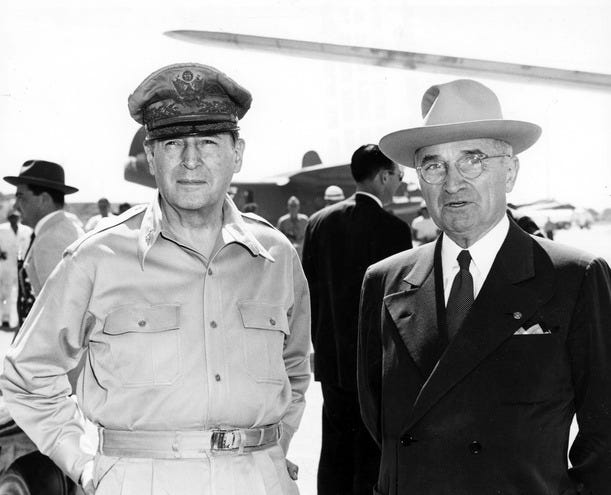
By 1950, General Douglas MacArthur was more than a soldier
— he was an American icon. A World War II hero who became the Supreme Commander for the Allied Powers in Japan, MacArthur was selected by President Harry S. Truman to lead the U.S. troops to victory in South Korea, with the goal to stop the spread of communism. With Truman concerned about American casualties, MacArthur assured him the war would be short-lived.
After driving North Korean forces past the 38th parallel, however, MacArthur continued to advance, and when Truman urged caution against expanding the war into China, MacArthur chafed; he believed in total victory, not limited containment. So, he spoke out, embarking on a public relations campaign in which he questioned the president’s wartime policies.
In letters and press statements, MacArthur mocked Truman’s strategy as timid, warning that appeasement would only invite further aggression. In a letter to Congressman Joseph W. Martin Jr., the general criticized the president’s limited strategy and advocated for a response with “maximum counter force.” His words, read round the world, directly undermined the president’s authority and the will of civilians in the middle of a volatile conflict.
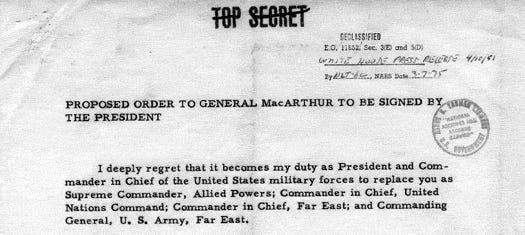
Truman faced a difficult choice: tolerate insubordination or defend civilian control of the military — a cornerstone of democracy — but face harsh criticism. After much consideration, he chose the latter and fired the nation’s most famous and beloved general. The public erupted in outrage; Congress demanded hearings. And while MacArthur returned home to parades and an invitation to speak before Congress, history would vindicate Truman, with Americans eventually coming to understand and appreciate his decision. His refusal to respond in kind to MacArthur or escalate the war likely prevented a third world conflict involving nuclear weapons.
Had MacArthur held his tongue or voiced his disagreement privately, the nation might have avoided months of dangerous brinkmanship. Instead, his actions had reverberating effects on the nation and world, deepening Cold War fears and fracturing national unity.
In an age when everyone feels compelled to speak their mind, how do you keep yourself in check?
“The one condition for fighting for peace and liberty is to acquire self-restraint.”
— Mahatma Gandhi

Humility, in the Stoic sense, is a great and, incidentally, useful virtue. If this last one were added to all the general's virtues, he would become almost a saint.