

Standing up for something in a seemingly know-nothing world
Sophie Scholl, Theodore Roosevelt and Margaret Chase-Smith offer inspiration.

Taking a stand
In our modern times, it can seem as if the act of taking a stand is something relegated to history books, folklore, myths, the Bible. Afterall, I doubt most of us find ourselves facing down a genocidal authoritarian regime, a mocking giant or a power-hungry sociopath.
Yet we face invisible giants every day … perhaps especially in the now times.
One person, feeling emboldened by their “platform,” disparaging another because of what they believe (or are purported to believe), where they are from, who they voted for or the causes they support. People refusing to publicly live by their values or stand for ideas for fear of being fired, ridiculed or simply disliked. Defaulting to compliance even when the situation demands moral action. Knowingly or blinding following rather than questioning and examining.
Your enemies are human, too

How John Steinbeck's unexpected contribution to the Allies' propaganda effort inspired Nazi resistance.
Far worse are those who are physically targeted because of their religion, race or some other characteristic.
But to ignore the fact that we have a choice is to deny one’s humanity — and that of others. Too often, throughout history, evil actors have gotten away with their deeds only because bystanders, either through willful ignorance or something as basic as a lack of curiosity, stood idly by.
But that is both the benefit and responsibility that come with having free will. It constantly asks of us, will we do what is easy or what is right?
Standing up requires movement, action, bucking the status quo — a conscious decision to act based on values as opposed to social cues, regardless of the personal costs.
It means acknowledging the human condition, instead of repressing it.
Like a muscle, the courage to take a stand, too, must be worked and stretched and fed. Standing up to my sister’s bullies in after-school care, standing up for a friend on the playground, standing up to a demeaning boss — it’s a muscle I’ve continued to develop over time, so that flexing it becomes easier and more natural.
As Greek philosopher Aristotle said: “We are what we repeatedly do, therefore, excellence is not an act but a habit.”
Remember then that heroes aren’t just the stuff of myths; they’re not confined to the page or screen. They too live and breathe and hope and bleed. They’re everyday folk … just like you and me.
And their actions, like our own, can have reverberating effects …
Such a fine, sunny
day, and I have to go …
It was a crisp February day, and Sophie Scholl stood bound by the gray stone walls of Munich’s Stadelheim Prison — a stark contrast to the bright blue sky stretching out above her. In front of her stood her interrogator, her older brother Hans, Chaplain Alt and a prison guard. Beside her, her executioner.
Perhaps she thought of her father in this moment … and how proud he might be if he could see her now.
For she was far from her days as a member of the National Socialist Party’s League of German Girls, which she’d joined to his chagrin, feeling a deep sense of pride in her country — before it, like all Nazi youth groups, was ultimately banned. Far from raised voices around the dinner table and her father’s chide remarks. From her time in the National Labor Service, waiting for her beloved Fritz’s return from the Eastern front, dreaming of a life without war.
It was a life she would never get to experience herself — but she hoped others soon would. Her time as a member of Die Weiße Rose, though brief, had quenched her thirst for meaning — and the resistance was only growing.
Although her story was coming to an end, she knew The White Rose would live on. And as she turned to face her executioner, she felt only contentment, stating:
“How can we expect righteousness to prevail when there is hardly anyone willing to give himself up individually to a righteous cause? Such a fine, sunny day, and I have to go ... but what does my death matter, if through us, thousands of people are awakened and stirred to action?”
Sophie Scholl was executed by guillotine on February 22, 1943, at the age of 21 for her role in the The White Rose resistance movement, which distributed anti-Nazi publications. Despite her death and the deaths of her brother, Hans, and friend Christoph Probst, The White Rose’s influence persisted. Copies of their final leaflet were smuggled out of Germany, reprinted by the Allies and dropped over German cities in July 1943.
Read more about Sophie Scholl’s bravery here.
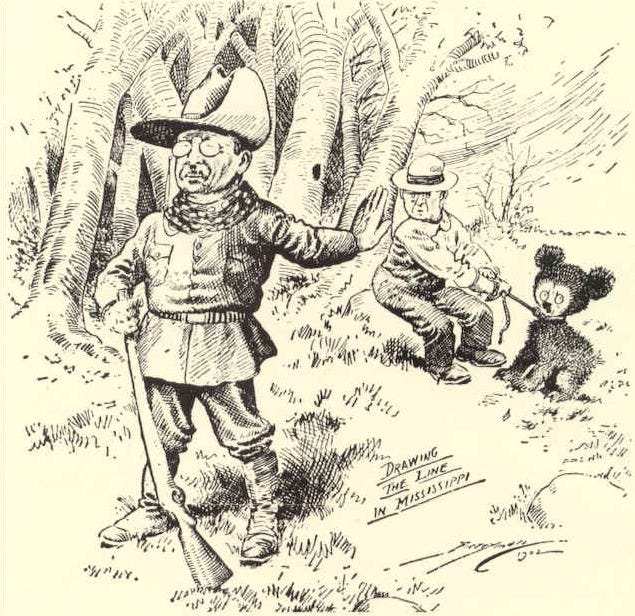
It was 1902, and President Theodore Roosevelt was accompanying Mississippi Gov. Andrew Longino on a bear hunting trip in the Magnolia State. With the hunt proving unsuccessful for Roosevelt, Longino and the other men — hoping to showcase the area’s abundant wildlife — proceeded to capture and tie a black bear to a tree for him to shoot. Roosevelt, for his part, believing this to be unsportsmanlike, refused, reportedly saying:
“I’ve hunted game all over America and I’m proud to be a hunter, but I couldn’t be proud of myself if I shot an old, tired, worn-out bear that was tied to a tree.”
Word of the incident spread quickly, with a cartoon appearing in The Washington Post two days later. And in Brooklyn, candy shop owner Morris Michtom decided to create and dedicate a stuffed bear to the president, calling it “Teddy’s bear.”
Read more about Roosevelt’s refusal here.
“Those of us who shout the loudest about Americanism in making character assassinations are all too frequently those who, by our own words and acts, ignore some of the basic principles of Americanism: the right to criticize, the right to hold unpopular beliefs, the right to protest, the right of independent thought.”
At the height of the Cold War, Republican Sen. Margaret Chase Smith delivered her “Declaration of Conscience” speech to the Senate on June 1, 1950. Her words, however, weren’t directed at communism; they were a pointed rebuke of fellow Republican Sen. Joseph McCarthy’s anti-Communist tirade, known as McCarthyism, when he led baseless investigations into communist infiltration of the U.S. government, Hollywood and other industries, and sparked widespread fear of political persecution. Smith was the first prominent member of Congress to publicly challenge McCarthy and condemn his witch hunt.
Read all of Smith’s speech here.
Just today, someone shared a post at FB by something called White Rose Resistance. It seems to be an anti-Trump, anti-big-business organization of some kind. I think the 'borrowing' of the White Rose name by people who are taking no risks and probably overlap only slightly, if at all, with the view of the Scholls and the others is, frankly, just obscene.
“Man is not fully conditioned and determined, but rather determines himself whether he gives in to conditions or stands up to them. In other words, man is ultimately self-determining. Man does not simply exist but always decides what his existence will be, what he will become in the next moment.” Amen.