Selling liberty: The propaganda campaign that funded WWI
The tactics conceived by President Wilson’s Committee on Public Information became the blueprint for engineering consensus in wartime and beyond.

“Propaganda does not deceive people; it merely helps them to deceive themselves.”
— Eric Hoffer
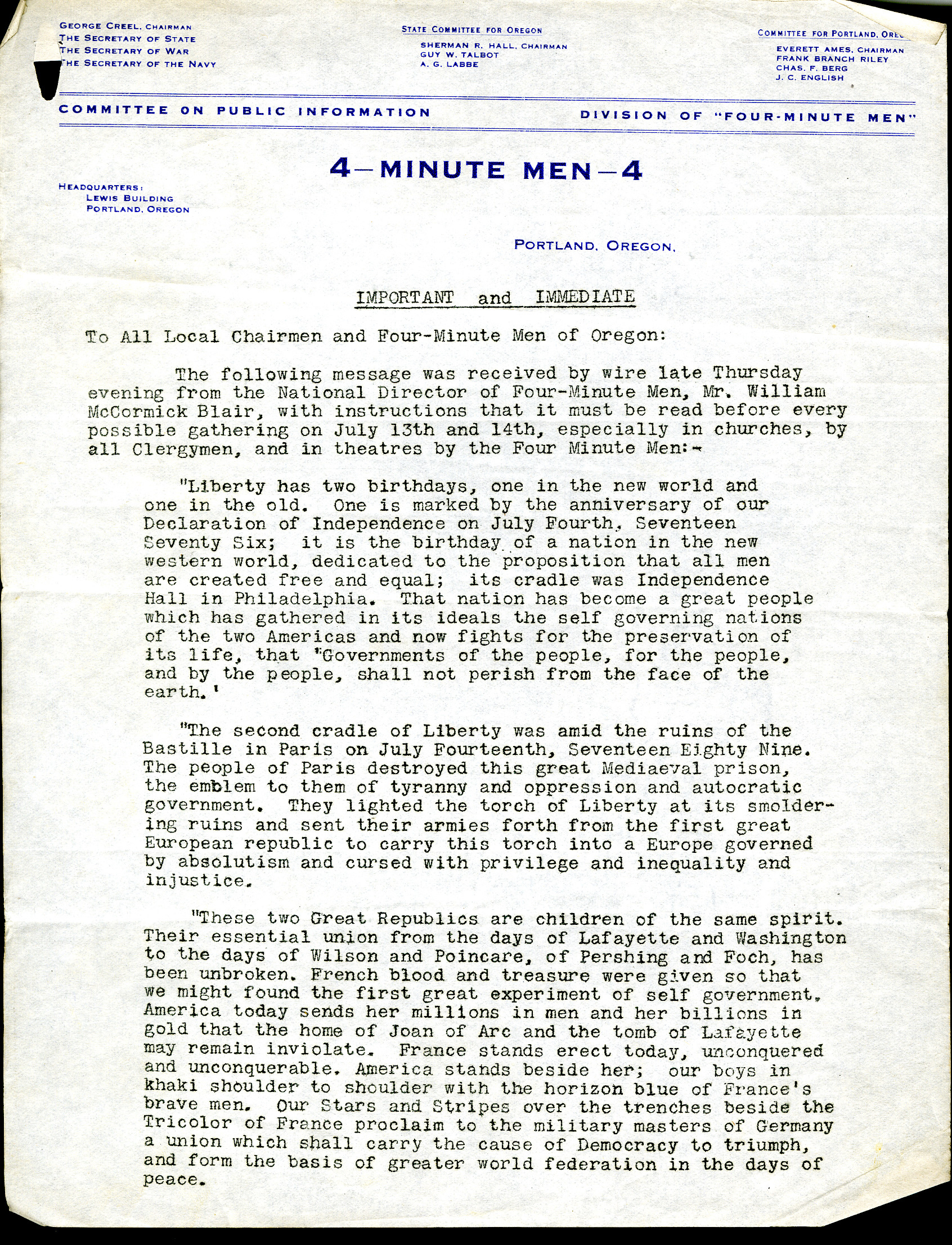
On July 14, 1918, William McCormick Blair addressed a crowd of moviegoers at one of Chicago’s many picture houses. He spoke passionately of the United States’ and France’s devotion to freedom and the reciprocity between the two “unconquered and unconquerable” nations.
A concerned citizen, Blair felt the weight of the moment.
Until the year prior, the United States had maintained its isolationist policy as Russia and France battled invading German troops. The 1915 sinking of British luxury ocean liner the Lusitania, which killed over 120 Americans, and the surfacing of the Zimmerman telegram, revealing an attempt by Germany to ally with Mexico, however, led President Woodrow Wilson to reconsider his position.
In April 1917, the U.S. joined the Allied Powers — which also included Great Britain, Italy and Japan — in their fight for sovereignty.
As Blair stood before the throngs of people, the war was still fresh on Americans’ minds, the date relevant.
“Liberty has two birthdays,” Blair declared, “one in the new world and one in the old. One is marked by the anniversary of our Declaration of Independence on July 4, 1776; it is the birthday of a nation in the new western world, dedicated to the proposition that all men are created free and equal; its cradle was Independence Hall in Philadelphia. …”
“The second cradle of Liberty was amid the ruins of the Bastille in Paris on July 14, 1789,” he continued. “The people of Paris destroyed this great Mediaeval prison, the emblem to them of tyranny and oppression and autocratic government. They lighted the torch of liberty at its smoldering ruins and sent their armies forth from the first great European republic …”
“These two great republics are children of the same spirit,” Blair added.
In the four minutes it took the projectionist to change the reels, Blair had delivered to a captive audience of Chicagoans an impassioned and impromptu speech.
Or, at least that’s how it appeared.
Bread and circuses: The follie of government assistance

How Rome's grain dole undermined the Republic's own advancement by creating a society incapable of fending for itself.
In 1916, President Wilson won re-election largely for his commitment to keeping the U.S. out of World War I — diverging from his opponents Roosevelt and Taft in a campaign characterized by the slogan “He kept us out of war.” Even as late as January 1917, Wilson continued to advocate for neutrality — despite pleas from France and its allies — delivering his now famous “Peace without Victory” speech to the U.S. Senate.
“I am proposing that all nations henceforth avoid entangling alliances which would draw them into competitions of power, catch them in a net of intrigue and selfish rivalry, and disturb their own affairs with influences intruded from without. There is no entangling alliance in a concert of power. When all unite to act in the same sense and with the same purpose, all act in the common interest and are free to live their own lives under a common protection.”
—President Woodrow Wilson, “Peace without Victory” speech
Thus when Wilson reversed course two months later, in April 1917, to declare war on Germany – most Americans opposed the move.
Anti-war sentiment remained pervasive, impeding Wilson’s ability to fund the U.S.’s war effort. Thus the administration needed a way to bring the public onboard. The way to do it, Wilson thought, was to create a unified public narrative as to why the war mattered.
Within a week of Congress declaring war, Wilson signed an executive order creating the Committee on Public Information (CPI), a temporary independent federal agency focused on increasing public support for the war. To lead it, Wilson enlisted American investigative journalist George Creel.
But if the CPI’s efforts were to be effective, they had to appear organic.
Standing before the crowd of moviegoers on July 14, 1918 – France’s Fête Nationale, commemorating the storming of the Bastille – Blair wasn’t simply a patriotic American stirred by the occasion. The prominent Chicago banker and civic leader was also the National Director of the CPI-led initiative the Four-Minute Men (named for the length of time it took to change a film reel), and he was there to rally the cause.
On this day of remembrance for France — which, more than a century prior, had helped the U.S. secure its independence — Blair’s goal was simple: to convince people of the need to support our long-time ally. His ulterior motive was to increase the sale of Liberty bonds.
Blair was one of approximately 75,000 Americans who served as Four-Minute Men – considered one of the CPI’s greatest tools for swaying public sentiment about the war. These orators delivered speeches to audiences not just at movie theaters but at churches, union halls, parks, school assemblies and other public spaces and events across the country throughout WWI. These individuals were often business owners and clergy, lawyers and civic leaders, neighbors and friends, and were trusted in their communities.
Neither the CPI nor its Four-Minute Men were clandestine; the press often referred to the CPI as “the war information service.”
But while Americans were aware of the agency and its programs, they weren’t aware of its playbook.
Speeches were uniform and scripted, as well as nationally coordinated, and their timing strategic. The appearance of spontaneity was engineered and was central to the CPI’s effectiveness. From 1917 through the end of WWI, an estimated 400 million people heard speeches from the Four-Minute Men.
But the CPI’s efforts weren’t limited to impassioned sermons.
In its movement to “make the world safe for democracy,” the agency employed a small cadre of writers, advertisers, artists and filmmakers who all shared Wilson’s and Creel’s sense that democracy was under threat. Lending an air of legitimacy to the project were familiar national figures like journalists Ida Tarbell and S.S. McClure, and illustrators Charles Dana Gibson and James Montgomery Flagg (famous for the “I Want You” U.S. Army poster).


At a time when most Americans got their news from newspapers, the CPI engaged in a vast campaign to shape public perception by controlling coverage of the war. This included efforts to overwhelm, confuse, suppress and cajole journalists and the newspapers where they worked.
The CPI issued daily press releases (approximately 6,000 total during its two-year existence), provided ready-made stories (along with photos and cartoons) and offered “voluntary” guidelines on how to cover the war.
Reinforcing the CPI’s efforts was the Espionage Act, which made it a federal crime, during wartime, to interfere with military operations or the draft or to speak, publish or distribute material deemed disloyal, obstructive or harmful to the U.S. war effort. Effectively the propaganda arm of the Espionage Act, the CPI made the cost of dissent appear high.
With relentless amounts of information and doubt cast on non-CPI-approved articles, wartime editors often published the agency’s pre-packaged stories as is.
The CPI’s soft edge coupled with the hard edge of the Espionage Act led both citizens and journalists to self-censor, fearing prosecution. As Creel later admitted, the CPI’s task was to “create an atmosphere in which the law would rarely need to be invoked.”
The tactic was simple: persuasion through saturation.
And while the medium varied, the messaging was always the same — calculated and visceral.
Posters, pamphlets, films, ads and newspapers — including the CPI’s own daily, the Official Bulletin — framed the war as moral rather than political, depicting the Germans as barbaric and inhuman, and the Allies as righteous and heroic. WWI wasn’t simply a war between adversaries; according to the CPI, it was a battle between good and evil.
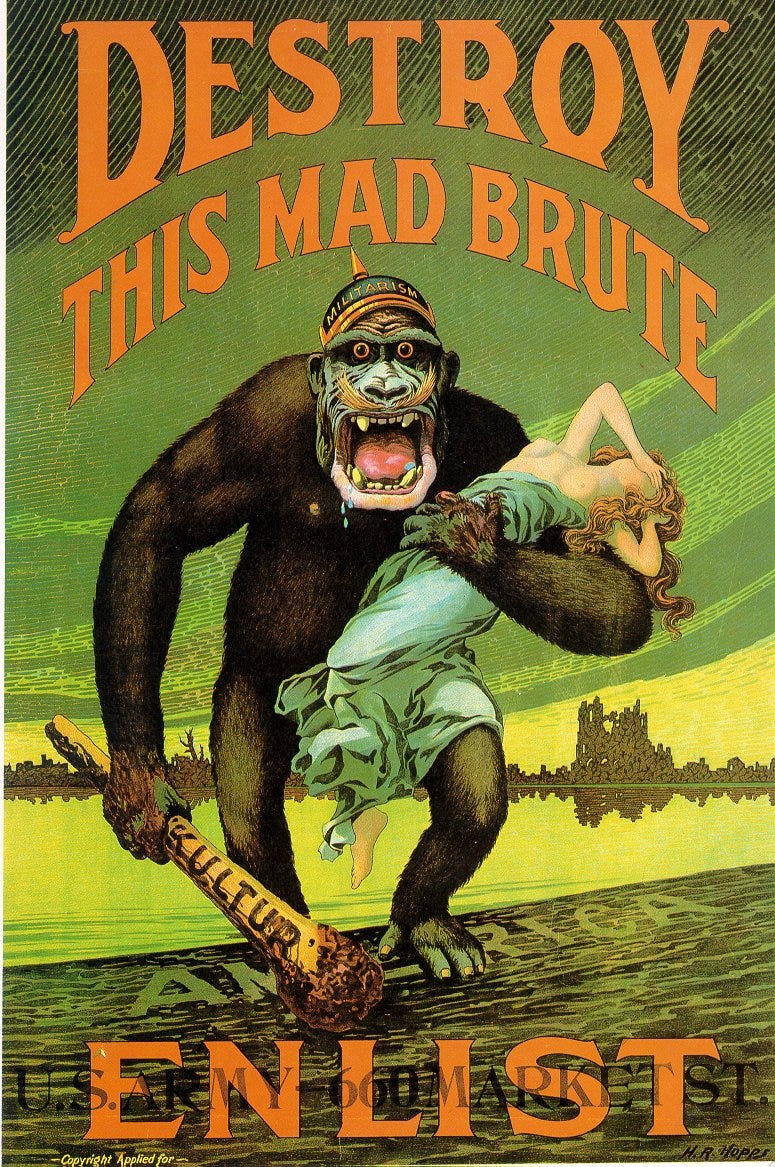
In this moral context, there was no need for enforcement. Peer pressure did the work — anyone who dissented was branded disloyal, or worse.
At a time when propaganda was not yet considered taboo and carried a neutral or even positive connotation, the CPI’s campaign worked. Americans didn’t just comply — they participated enthusiastically.
Not only did the CPI foster consensus around U.S. involvement in WWI, it’s also credited with helping bring in over $21 billion in Liberty Loans — an enormous sum at the time — as well as driving Red Cross enrollment, draft compliance and volunteerism. The CPI and its team of citizens, writers, filmmakers and artists had shown that public opinion can be engineered.
While many Americans later reported being shocked by how quickly support for the war grew, the CPI’s efforts show how easily a small, coordinated group can sway public opinion — for good or for bad. Influence, it was discovered, is most powerful when it’s visible enough to feel legitimate but subtle enough to feel natural.
The one who controls language controls reality

Rhetoric, the Sophists of ancient Greece taught us, isn’t about sharing truth, but about winning arguments.
The CPI proved that you don’t need to convince people of facts so long as you can shape the moral and emotional context in which they’re received.
This level of psychological sophistication is one we continue to see today.
As CPI volunteer Edward L. Bernays (nephew to Sigmund Freud) wrote in his book Propaganda in 1928, “The conscious and intelligent manipulation of the organized habits and opinions of the masses is an important element in democratic society. Propaganda is the executive arm of the invisible government.”
The lessons of the CPI, however, aren’t confined to government or politics.
Following WWI, many of the agency’s tactics became commonplace in the advertising and public relations industries. Today they’re the weapons of activist movements, corporations, media companies and terrorists, as well as governments and political parties. The subtlety of their messaging as well as its placement and repetition — enforced by algorithms, tribalism and pressure to conform — make CPI tactics some of today’s most powerful weapons for exploiting the masses through emotional and social manipulation.
As Creel later wrote in his book How We Advertised America, “Public opinion is not based upon reasoning alone, but upon feeling and impulse.”
Sources:
https://www.smithsonianmag.com/history/how-woodrow-wilsons-propaganda-machine-changed-american-journalism-180963082/
https://prologue.blogs.archives.gov/2011/04/04/the-wilsonian-path-to-war/
https://woodrowwilsonhouse.org/election-1916/
https://www.pbs.org/wgbh/americanexperience/features/when-wilson-asked-war/
https://online.norwich.edu/online/about/resource-library/isolationism-and-us-foreign-policy-after-world-war-i
https://doughboy.org/committee-on-public-information-when-the-u-s-used-fake-news-to-sell-americans-on-world-war-i/
https://www.loc.gov/exhibitions/world-war-i-american-experiences/about-this-exhibition/over-here/surveillance-and-censorship/four-minute-men/
https://www.oregonhistoryproject.org/articles/the-4-minute-men/
https://historicmissourians.shsmo.org/george-creel/
https://www.jackmillercenter.org/our-work/resources/espionage-sedition-acts