Laughter is the only medicine
In the next essay in our "I believe" series, I explain why I believe laughter is a prerequisite for survival.

“A sense of humor is a measurement of the extent to which you realize that you are trapped in a world almost entirely devoid of reason. Laughter is how you release the anxiety you feel at this knowledge.”
— Dave Barry
I believe that humans need laughter in order to survive … in more ways than one. I believe laughter is a natural reaction to our often overstimulating, overwhelming, over-stressed lives, as well as an effective weapon against fear. It helps ease tension and stress, bridges divides, brings people together and reminds us to not take ourselves too seriously.
On September 29, 2001, SNL aired its first episode following the 9/11 terrorist attacks. The show opened on a somber note, with then Mayor Rudy Giuliani appearing on stage alongside members of the NYPD and FDNY and, following a performance of “The Boxer,” musician Paul Simon. Speaking to the audience, Giuliani said:
“On September 11th, more lives were lost than on any other single day in America’s history, more than Pearl Harbor and more than D-Day. … Our hearts are broken, but they are beating, and they are beating stronger than ever.”
Joining the men on stage, producer Lorne Michaels famously asked Giuliani, “Can we be funny?” To which Giuliani plainly replied, “Why start now?” Drawing what was arguably the biggest laugh of the night, the moment was a signal to Americans that it was OK to laugh again. That despite the horrific tragedy of just a few weeks earlier, sometimes laughter is the best, if not only, medicine.
The episode — although uncomfortable at times — offered a respite from the emotional toll of the preceding weeks … and served as an invitation to begin the healing process.
Danish-American comedian and pianist Victor Borge was right when he said, “Laughter is the shortest distance between two people.” Our sense of humor may vary, our proclivity for laughter, but laughter’s ability to erase all fears, anxieties, disagreements and limitations, and bring people together even amidst tragedy — even if just for a moment — is ubiquitous.
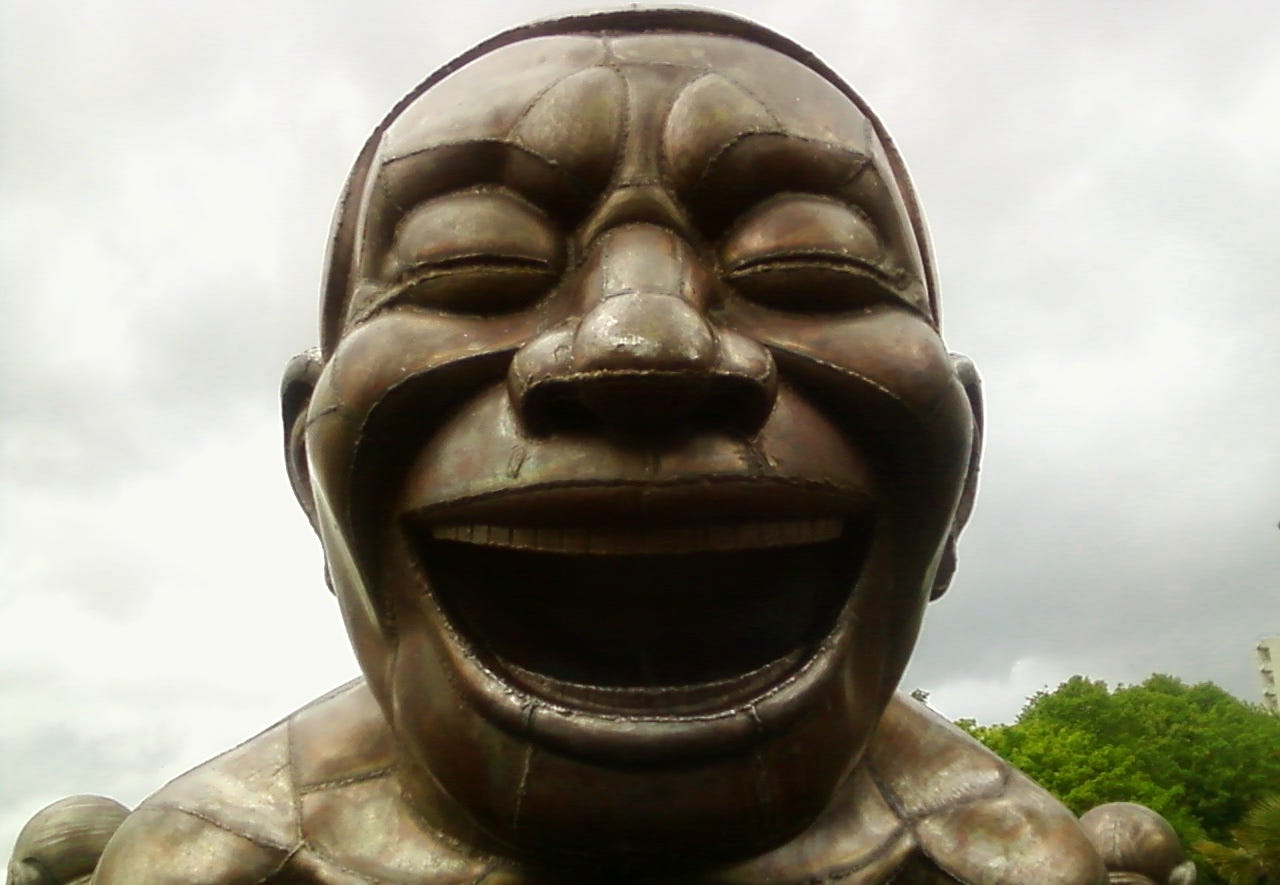
I believe we need to laugh regularly, deeply and often.
And when we fail to, we pay for it with an emptiness that can’t otherwise be filled — a feeling not unlike that of hunger, that begins in the pit of the stomach and eventually, if ignored long enough, embeds itself into all areas, situations and interactions. It stretches into our work and attempts at play, into our conversations and relationships, and like a shade, its very absence can darken our perspective and experiences.
At its best, laughter is highly contagious … as my family and I learned during a recent front-yard camp-out. As our 7-year-old — exhausted and feeling the effects of her smore — began to laugh uncontrollably, every word we uttered or sound we made just adding fuel to her delusional stupor, we, too, found ourselves responding in kind. Her cycle of cackles, followed by heavy signs and a brief period of silence, triggered in us a visceral, at times uncontrollable, reaction as well.
This type of uncensored, no-holds-barred kind of laugh – that comes from the back of the throat, somewhere deep in the esophagus, that leaves no question as to its authenticity — is one of the most wonderful, honest things a person can experience. My daughter’s laugh is that — when my 4-year-old son makes one of his uniquely Otto comments (“We don’t eat people,” for instance) or my husband stares at her with crossed eyes from across the dinner table, she breaks into a beautiful, unrestrained howl – head tilted upwards, eyes closed – that makes it impossible to not join in.
As Charles Dickens noted, “There is nothing in the world so irresistibly contagious as laughter and good humor.”
So, when the world gets to be too much, when I feel like I might cry if I don’t laugh – or we all simply need a good chuckle – my family and I will flip on a good comedy, attempt a few tongue twisters or listen to a favorite comedian. And occasionally, we’ll pull out my list of “Otto-isms” (“I didn’t know there were farms in this world,” “If we do a haircut, my hair still grows when I go outside,” or, one of my personal favorites, “We don’t want to cut our heads off”), reading them off one by one until I hear the familiar unrestrained howl of my daughter and the bubbly giggles of my son, and eventually my own rhythmic chuckling, as all else becomes noise.
What makes you laugh hardest, and where do you seek out laughter?
“The human race has only one really effective weapon and that is laughter."
— Mark Twain