Is the ‘Bridging’ movement the counterculture of our time?
With acceptance of political violence at an all-time high, a silent but growing number of college students – members of BridgeUSA – are showing Americans it's OK to disagree.

“If free speech is not protected on campus, you can’t expect it to last
all that long off-campus.”
— Greg Lukianoff, FIRE president
When Nicholas Huber entered the University of Tennessee at Knoxville as a freshman, he found himself engaging in deep conversations about religion and politics with a student, whose name was Jack, who lived across the hall from him.
“This happened pretty consistently — I’d say maybe once a week,” recalls Huber, who is currently a junior finance major at UT-Knoxville.
A seemingly unremarkable occurrence, discussions like this have long been a defining characteristic of college campuses. Considered bastions of free speech, American colleges and universities have been the centerpoint of dialogue, debate and protest since even before the 1960s — the first reported protest, known as the “Butter Rebellion,” taking place at Harvard University in 1766 (when students protested the poor food quality).
The Free Speech Movement as we know it, however, began in 1964 on the University of California, Berkeley’s campus. Student activists staged sit-ins that resulted in the administration overturning restrictions on political free speech and advocacy on campus. This and the many demonstrations that followed effectively earned UC Berkeley its title as “home of the Free Speech Movement.”
The campuses of today, however, bear little resemblance to those of the 1960s — including Huber’s own.
His experience is notable not just because he’s having these discussions, but because he and Jack agree on very little. “I came from D.C. where it’s very liberal. [Jack] came from Memphis and grew up deeply religious, as a Christian, and ended up converting to Catholicism. I grew up not at all religious,” Huber says. “Even though we came from vastly different backgrounds and we have very differing opinions, we really enjoyed the conversations — to the point that we kept coming back.”
Huber and Jack’s interactions, however, are the exception — not the norm.
No longer the centerpoint for discussion and debate, colleges are instead often flashpoints in today’s culture wars — the atmosphere one that no longer fosters openness, but rather stifles opposition.
Just ask the students.
Every year, the Foundation for Individual Rights and Expression (FIRE) surveys college students to assess the state of free speech on U.S. campuses. FIRE’s 2026 College Free Speech Rankings, which polled 68,000 students at 250-plus colleges, found that 28% of respondents self-censor in the classroom (up 2 points over last year), while 24% self-censor among fellow students.
Consider also a 2024 BestColleges survey in which 44% of the 1,000 students polled said they feel comfortable expressing their opinions on campus without fear of punishment (that’s 56% who don’t feel comfortable). Disaggregated by political party, 54% of Democrats and 39% of Republicans feel comfortable sharing their views on campus.
Huber, however, like a growing cohort of young people, is committed to changing this.
After receiving an Instagram DM from someone at BridgeUSA, an organization whose mission is to empower young people to engage in constructive dialogue and disagreement, Huber started a chapter at UT-Knoxville and now serves as its president. With 108 chapters on college campuses across 41 states, BridgeUSA engages nearly 22,000 students each year. Founded in 2017, the organization is growing in spite of – or perhaps because of – political polarization.
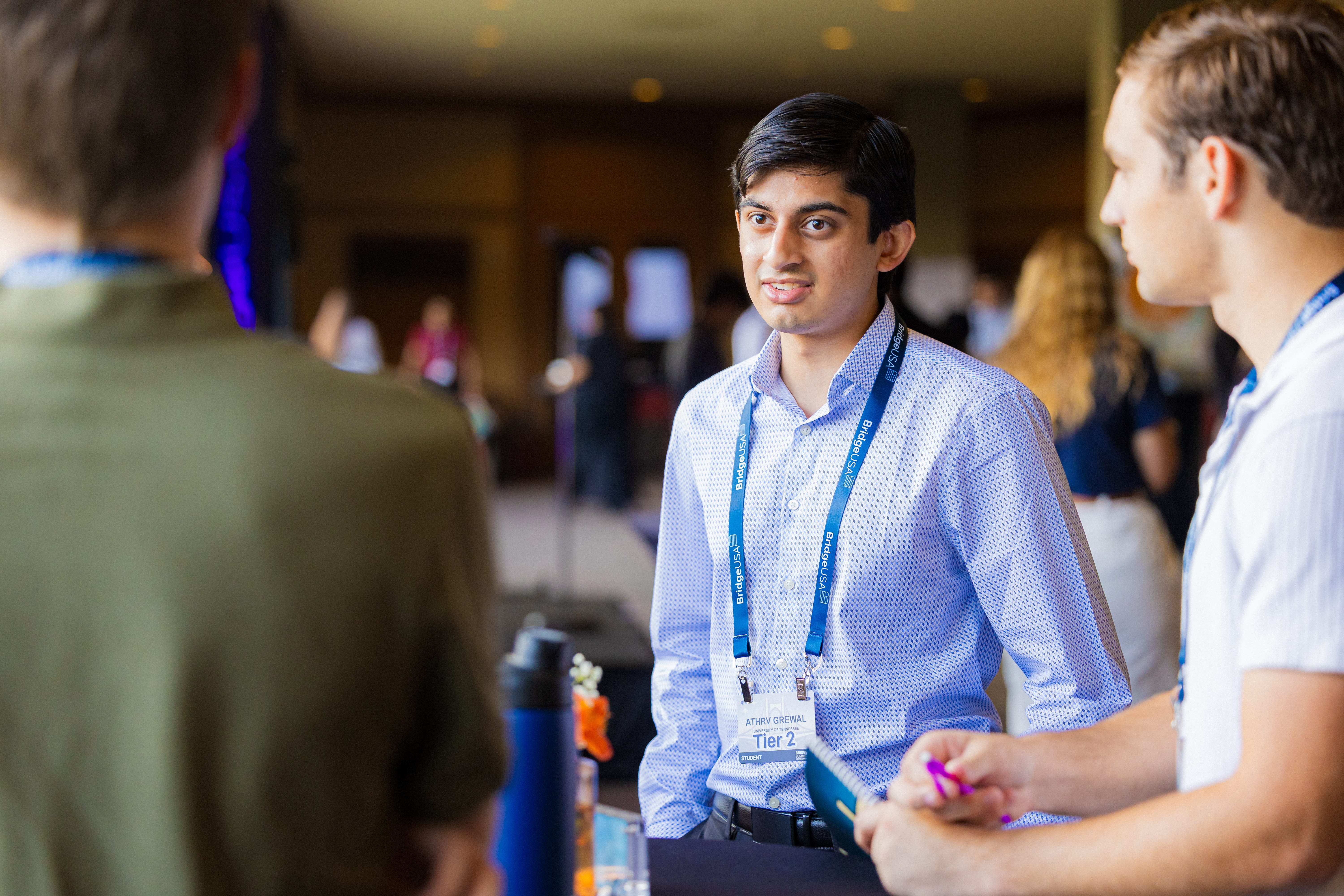
“That’s basically what [Jack and I] were already doing — we were just chatting about politics in a respectful manner; we weren’t getting angry,” says Huber. “We were doing it between the two of us anyway, and we decided to spread the love, so to speak, to other students.”
Imagine — instead of an emotionally charged, hyperpolarized, regressive national climate — a thriving U.S. democracy where leaders and citizens engage in respectful, productive dialogue. That’s not a pipe dream; it’s BridgeUSA’s vision. And it only seems natural to start on college campuses.
“The leaders of tomorrow are on today’s college campuses,” says Manu Meel, founder and CEO of BridgeUSA. “If you can’t settle the most complicated issues of our time on a college campus, then where will you settle them? Campuses need to be homes of intellectual inquiry — not just free speech, but free speech that enables us to really serve and understand each other.”
Learning to respectfully disagree
In 2017, following the contentious 2016 election, Meel was a pre-med student at UC Berkeley, when violent protests erupted ahead of right-wing commentator Milo Yiannopoulos’ planned appearance.
Approximately 1,500 protestors, including 150 masked agitators – some not affiliated with the university – came together to protest the then editor of Breitbart. According to reports, they threw commercial-grade fireworks and rocks at police, hurled Molotov cocktails, smashed windows and attacked two Berkeley College Republicans. By the time university officials made the decision to cancel the event “out of concern for public safety,” protestors had caused $100,000 worth of property damage and injured six people.
Meel recalls the moment vividly.
“I was walking past a cafe and the window was shattered. There was a TV screen that said, ‘UC Berkeley students protest Breitbart speaker’s speech,’ and the television crew that was filming that was standing right next to me,” he says. “That sort of shattered the fourth wall for me — you suddenly feel like you’re not a spectator, but that you’re actually someone who has some responsibility to do something because you’re a member of this community.”
Born in New Jersey and having moved around every two years as a kid, including to India, Meel says he was already someone who was naturally a “bridger” — a term he uses to refer to people who believe their views can be “strengthened, improved or refined” by speaking with people with differing views. In response to the events of that day, he, along with a few friends, launched BridgeUSA to address what they saw as the downward spiral of campus politics and free speech.
“The goal was very simple,” says Meel. “It wasn’t to create compromise, nor was it to try and get people to find common ground. It was to help people understand why the people they disagree with believe what they do.”
Thus, on the campus that was once the paragon for civil debate and disagreement, Meel and his peers spearheaded a new movement — one focused on cultivating respect for differences of opinion.
“The goal is very simple: It’s [to] enable the next generation to adopt and champion pluralism in one of the most divided times in American history,” he says. “The work is driven by a very simple proposition — that the United States is the most diverse democracy in the history of democracies, so we believe that ‘bridging’ and dialogue are going to be 21st century skills if this democracy is going to succeed. Our goal is to enable that.”

BridgeUSA does this by building up its chapters; Meel hopes to get to 800 over the next five years. The bread and butter of the organization, chapters are focused on driving a sense of civic community on campus through events large and small, professional and social.
These include intimate bimonthly dialogues where students engage in conversations about modern challenges and issues. Although these are led by a moderator who creates questions to spark discussion, Huber says participants can talk about any topic or a personal experience, if they’d like. “Ultimately, people stay more engaged if they can talk about personal experiences,” he says. “I think it makes it feel less like a classroom if the students have more autonomy and more control over the conversation.”
“The goal,” Meel notes, “is to create a constant space where students can show up because they know that’s the place where they can talk about contentious issues affecting the community.”
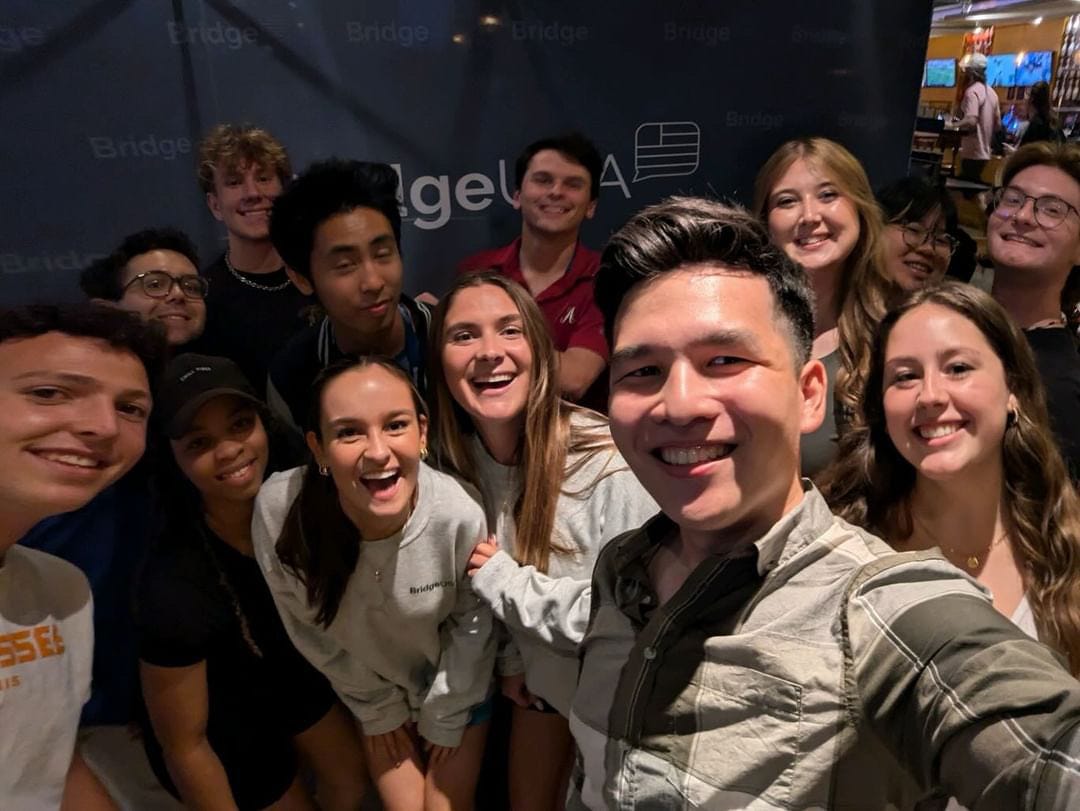
BridgeUSA’s more formal workshops are experience-based and are designed to provide students the tools and skills for effective dialogue and leadership, with a focus on critical thinking, empathy and inclusive communication. But perhaps more than building these critical skills, BridgeUSA hopes to make these conversations welcoming.
“How do you make pluralism and bridging not some kumbaya, esoteric, abstract activity, but a way for people to find genuine friendships and connections?” says Meel.
He believes loneliness is fueling much of the current polarization and hopes to address both issues by bringing students together to form friendships across differences.
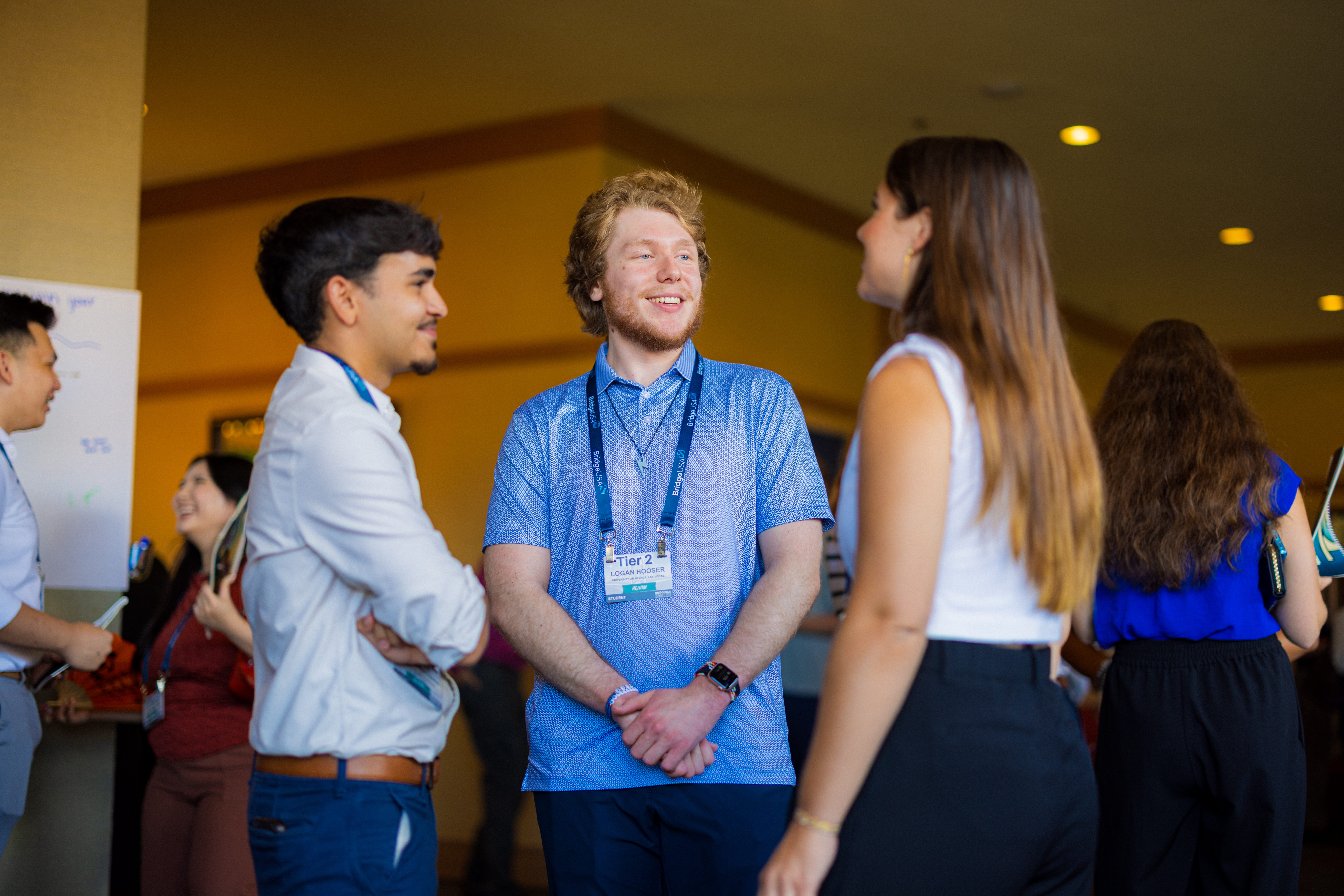
“What we try to do is create an environment where talking about politics is fun and it’s not taken so seriously,” Huber says. “We try to remove the stigma from it. A lot of times when people hear the word ‘politics,’ they’re like, ‘Oh, this is going to lead to an argument. Let’s not talk about this.’ We try to make it so it’s like, ‘Hey, just come talk, just come have some fun. There’s no harm if you don’t want to talk. You can just come and listen. It’s free food and a good time.’”
The organization surveys participants both before and after each event to gauge how their feelings about discomfort around dialogue and disagreement may have shifted. Called the Bridging Polarization Index, it assesses attitudinal changes along four vectors: listening, curiosity, pluralism and the ability to disagree. “We look at that measure over time to see whether or not students are actually experiencing statistically significant changes in how much more tolerant they are through their participation in BridgeUSA, or how much more likely they are to listen to the other side,” says Meel.
And while Huber doesn’t think anyone’s ever changed their political party because of these events, that’s not really the point.
“As far as success goes, we mainly look at attendance and, this is going to sound really lame, but the vibes in the room,” Huber says. “If people are laughing, having a good time, staying after and talking to one another, then we consider it a success. If people are eager to leave, then that’s indicative of a problem on our end.”
Having the courage to disagree
For young people used to self-censoring, coming together to speak frankly about their political views with others, particularly those across the proverbial aisle, can feel unnatural and unnerving.
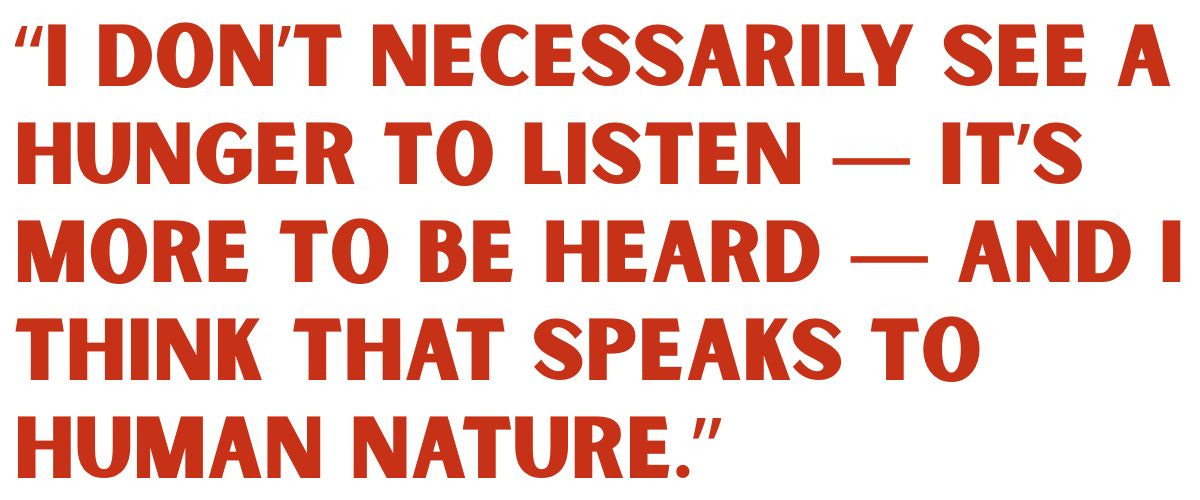
The problem isn’t necessarily that students don’t want to share their views; it’s that they don’t want to discuss or debate them with someone they disagree with. “I don’t necessarily see a hunger to listen — it’s more to be heard — and I think that speaks to human nature,” Huber says. “I think everybody inherently wants their voice to be heard, which is fine, but I think students especially need to overcome that feeling.”
“When students protest on campus, ultimately they end up seeing many students walk right by them with their earbuds in,” he adds. BridgeUSA events, however, offer an opportunity for these students: “the promise of a group of 30 to 40 students who are here to talk, but also here to listen to what you have to say,” Huber says.
But, in an era of increasing political violence, BridgeUSA has its work cut out for it.
In FIRE’s College Free Speech Rankings poll, 34% of students said that using violence to stop someone from speaking on campus is acceptable, while 72% said shouting down a speaker on campus is acceptable — at least in rare cases for both. A study by the Skeptic Research Center revealed a similar sentiment, with nearly 1 in 3 Gen Zers and millennials expressing support for political violence, with support highest among those identifying as “very liberal” — particularly Gen Z women.
But for those students who still believe in the value of free speech and tolerance, BridgeUSA offers a much-needed refuge.
In the hours following Charlie Kirk’s assasination, students at BridgeUSA chapters across the country began coming together to engage in conversations. “What was fascinating was the amount of ideological diversity we saw in those rooms that night because it was, frankly, the only place where students could go,” says Meel. “There’s a grassroots populous energy that I think motivates a lot of these students to trust BridgeUSA chapters just because that’s where their peers are.”
Although Meel disagreed with Kirk on more than just objectives, he says he “deeply respected” him for his willingness to engage. “He was one of the only people on the Right who would show up for any conversation,” he says.
Beyond the quiet halls and the held tongues, however, a quiet energy appears to be building on college campuses — Huber’s experience and BridgeUSA’s growth a testament to this. More and more students are finding not just the courage to speak, but to listen.
“There’s a real counterculture brewing on college campuses,” says Meel. “The norm in 2017 was not violence. The norm today is violence, which means that young people who are standing up and saying, ‘We’re going to have a conversation [in] the face of conflict,’ they’re actually the courageous ones.”
The simplicity of the goal — “adopting pluralism as the norm,” Meel says — doesn’t make it any easier to achieve, but he intuitively believes in the ability of young people to make a difference.
“College students have tremendous cultural power. I think historically of Vietnam War protests or the apartheid movement or the Civil Rights Movement,” says Meel. “College campuses can really drive the national conversation.”
Where do you see progress toward pluralism on college campuses?
What role should these institutions play in fostering in students the skills to disagree respectfully?
To read more from my interviews with Meel and Huber — in which we discuss the connection between the loneliness crisis and polarization, what Meel believes the true divides are between Americans (hint: it’s not between the Right and Left) and the role that colleges should be playing with regard to dialogue and disagreement — become a Spirit & Sword paying subscriber today.

Up Next:
One America Movement is preparing faith leaders and their communities to confront toxic polarization.
See also:
Braver Angels is using marriage and family therapy principles to bring us back together again. Read the story.