How to escape the cave of our ignorance
A conversation with Robin Reames, author of "The Ancient Art of Thinking for Yourself."

“Ignorance is the curse of God, knowledge the wing wherewith we fly to heaven.”
—William Shakespeare
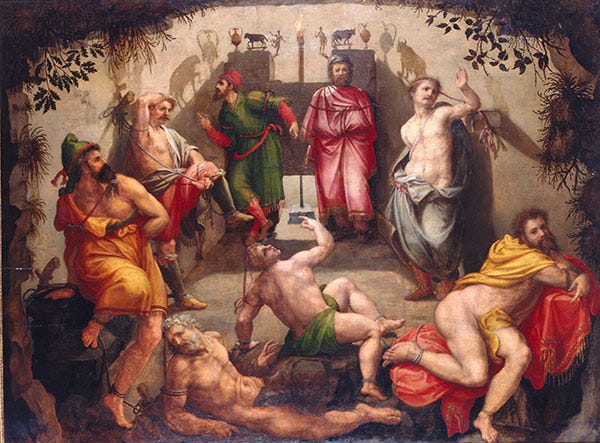
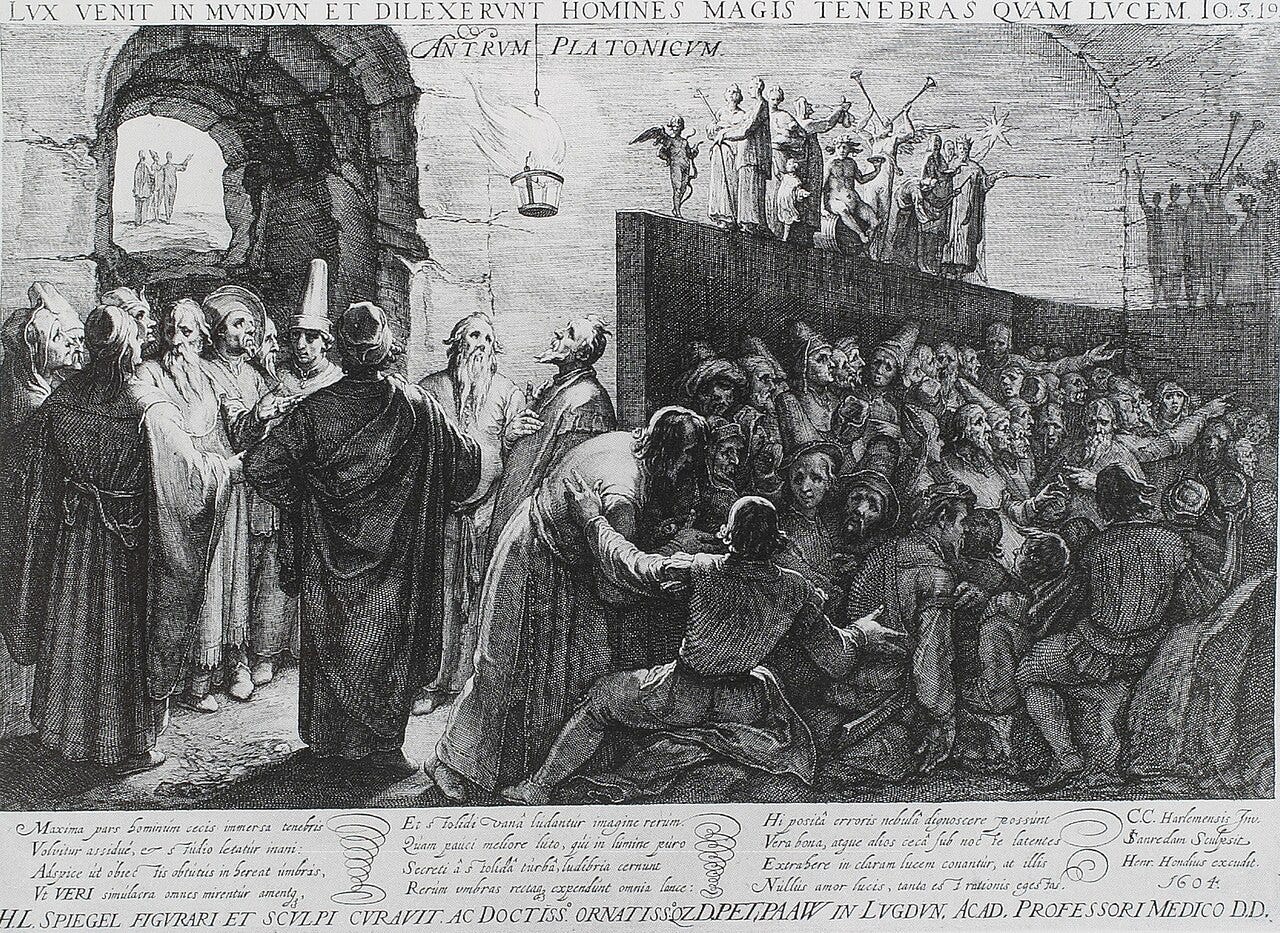
Let’s imagine you’ve lived your entire life in a cave …
Chained alongside others, you face the cave’s back wall, upon which figures and objects move about. Unable to turn your head, the comings and goings of these figures, including the noises they make, are all you and your commrades know and all you talk about. To you, they are the truth.
One day, however, you’re released from your chains and begin to make your way out of the cave. Along the way you see people with objects walking to and fro in front of a glowing fire, casting their shadows — the figures you were accustomed to seeing — on the back wall. Beyond that, the bright light from the cave’s entrance makes it difficult to see, disorienting you. Instead of pushing through your confusion and discomfort and continuing on, you rush back to the familiarity of the dark cave. If someone then tried to force you out, you’d resist.
If, however, you made it outside, after some time, you’d grow accustomed to the light and realize how limited your knowledge had been. You would realize that life beyond the cave is, in fact, the true reality, as opposed to a distorted representation of it.
“The cave of our ignorance is the only reality we know, and because it is familiar, it’s preferred,” writes Dr. Robin Reames, an associate professor of English at Indiana University Bloomington, in her book The Ancient Art of Thinking for Yourself: The Power of Rhetoric in Polarized Times. “Given the choice between a familiar lie and an unfamiliar truth, we’ll choose what’s known, familiar and comfortable. Even when it’s killing us.”
Although a metaphor to describe man’s ignorance, Plato’s allegory of the cave bears much resemblance to reality. Of course we’re not chained in a cave taking shadows on the wall for truth; yet our world is nonetheless distorted and our ignorance real. Rather, our eyes are glued to screens, believing whatever version of reality we’re served by the algorithms, politicians, influencers and news media. But because we’re incapable of seeing and experiencing everything for ourselves, we’re forced to rely on these secondary sources of information — all of whom have their own motives.
“So many of our online forms of media conform to superficial genre conventions that give the sense that they are ‘news,’” Reames writes. “It distracts us from noticing that, when it comes to what kind of action they are trying to perform in the world, they fall in a different category altogether — not the category of reporting what happened, but the category of telling you what to think about what happened and how to behave in response. They’re aiming to ignite our passions and mobilize our reactions rather than merely inform.”
Yet, as Reames notes, we’re not helpless against them.
In The Ancient Art of Thinking for Yourself, Reames explores the importance and utility of a tool that dates back to ancient Greece — rhetoric (i.e., the art of persuasion). By exploring the origins and impact of rhetoric, she offers a roadmap for how to counter it. I recently spoke with Reames via email to find out how the study and use of rhetoric applies to our modern times and how it can still aid us today.
In your book, you begin by sharing the story of the Sophists in ancient Greece. Today, sophist is a catchall term for people who use clever, deceptive language to persuade others, often for personal gain. Why were the Sophists able to have such success in Greece, and what conditions allowed them to flourish? What parallels do you see to today?
There is a long, complicated answer to this question that is spelled out in more detail in the book. Without reproducing that full explanation here, I’ll just say that before the rise of the Sophists, Greece had recently undergone a massive technological revolution due to the spread of literacy. The Sophists were the first “tech bros” in a sense, because they were the first people to recognize the social and political implications once speech could be severed from the speaker via writing. Suddenly, people could experiment and play around with words rather than be bound to them, and this meant that it was possible for people to be less accountable for their words, which caused massive implications for truth.
In a similar way, the spread of falsehoods today is accelerated by social media and the rise of AI, where the message struggles to keep up with the medium. Truth and accuracy become more vulnerable when people are unable to distinguish between the words people say and the things those words represent — between reality itself and the supposed reality that’s packaged in words. Our natural tendency to look right past or through the language rather than at it is in many ways unchanged from then to now. The art of rhetoric was invented to help people learn how to look at the language itself and to identify what makes it persuasive and believable.
If negative emotions such as anger and fear activate our brain’s reward center in the same way drugs or gambling do (i.e., we become addicted to negative emotions) — as you note in the book — what does this say about the modern news media’s business model, as well as that of social media companies?
There is an entire field of study behind the design of the platforms, which teaches engineers to harness cognition in the way you describe and to bypass our critical faculties. But as a rhetorician, I don’t study business models. Rather, I teach people that, even if an entire industry aims to persuade them without letting them know they are being persuaded, no one can stop them from studying rhetoric to learn why certain words have the power to make them angry, happy, sad or fearful.
The first study of the psychology of human emotions in the West is found in Aristotle’s book on rhetoric precisely because Aristotle realized that emotions enter our minds and bodies through words, and if we learn to control the power words have over us, then by extension, we can control our emotions as well. We don’t need brain scans to be successful at this; all we need is to understand rhetoric.
“If changing minds is equivalent to changing cultures, to becoming an outsider where we once were insiders, who among us would be brave enough to critically evaluate our political views?”
—Robin Reames, The Ancient Art of Thinking for Yourself
You write that “the further we are from rhetoric and argumentation, the closer we are to violence and coercion.” Rhetoric today is used by many to deepen polarization and drive Americans further apart. So how can we use rhetoric for good, to counter this type of division?
Studying rhetoric is a matter of understanding how language propels belief. Suppose someone’s words, chants, slogans and so on, are intended to provoke anger, fear and thus violence. Someone who studies rhetoric understands that link, as cause and effect, and is arguably less easily provoked or manipulated as a result. They also understand how persuasive arguments work, so they can use argumentation (as opposed to incendiary chants and slogans) to reason with their opponents. This is how studying rhetoric clears a path away from violence and toward the kind of deliberation that’s necessary for a democracy to thrive.
The Greek’s idea of freedom emphasized less focus on the individual and more on the needs and concerns of the public. What did this look like in terms of rhetoric? Enforcing this type of civility obviously takes away some level of individual freedom, so how can we as a society reinforce this focus on the public good without forcing it?
Our assumption these days that freedom is more or less equivalent to individual freedom is possibly one of the greatest obstacles to overcoming our political polarization and ideological thinking. When democracy arose, by contrast, there was a fundamental understanding that freedom depended — utterly and absolutely — on social coordination and common well-being as opposed to individual freedom.
The one who controls language controls reality

Rhetoric, the Sophists of ancient Greece taught us, isn’t about sharing truth, but about winning arguments.
They believed that prioritizing individual well-being over the common good was, in a word, tyranny: Politics organized around the individual prioritizes the one over the many; politics organized around the common good prioritizes the many over the one. It’s not so much a question of force as a matter of what kind of politics each set of priorities gives rise to.
In your book, you talk about the notion that rhetoric can create an alternate reality, so at what point does persuasive language stop describing reality and start replacing it?
We can never access reality directly — it always must be packaged for us. The goal is for the packaging to attempt to match, rather than to deliberately distort, reality. Rhetoric arose as a discipline so that people would have a technique for assessing what the packaging was doing and how it was made to be persuasive and compelling. Because we have neglected the study of rhetoric for so long, our critical faculties have grown somewhat atrophied in this task. But it’s never too late to begin again! And luckily, all that rhetorical wisdom is still there, waiting for us to relearn it.
Knowing how increasingly difficult it is to know what truth is considering these alternate realities and the rise of AI, does thinking rhetorically come down to simply being aware of the impact of words, rather than whether they’re conveying truth? And what does this say about the value of curiosity and the danger in certainty?
The question of certainty is particularly important. In Aristotle’s politics, ethics and rhetoric (which he interwove as a single tapestry), he makes a stark distinction between things done by humans and things that happen as a matter of mathematical, geometrical or scientific necessity. Unlike mathematics, geometry, astronomy and so on, the things that humans do are fundamentally unpredictable and ever-evolving, so they can only ever be contingent rather than necessary. This means that what we think about them can only ever be probable.
2 + 2 can only be 4, but the best course of action in politics is much harder to determine. The problem these days is that our wires seem to be crossed. We think of things like politics and ethics as absolute, and we treat science like it’s only an opinion. To properly uncross these wires, we should realize where certainty is appropriate and where it’s a misfit to the subject. And in politics, certainty is a misfit.
What we should aim for in our political life is what’s better, rather than what we believe is certainly or absolutely true. That’s what Aristotle would have us do, in any case.
Some examples of manipulative rhetoric are obvious; other examples are more ambiguous. So, what rhetorical signals should people watch for when consuming news or political commentary in particular? What habits can people cultivate to help them resist rhetorical manipulation?
A good starting place for learning is beginning to simply notice when you feel a strong response to certain rhetoric — whether it makes you angry, sad, fearful, etc. That’s the first step of beginning to think rhetorically rather than ideologically.
The next step occurs by learning the terms and concepts that developed over more than 2,000 years to explain how and why the words made you feel that way. The rhetorical tradition is composed of — I’m not exaggerating — literally thousands of terms and concepts for understanding how language tricks and manipulates. It’s here that I would direct readers to read the book.
In the book, I’ve selected out some of the most compelling and important ones, and there isn’t really a shortcut for learning how to spot the tricks of language. I wrote my book to make that 2,000-year-old tradition more legible and navigable, so that readers today could gain the same sense of empowerment that Aristotle’s own students may have had all those years ago in his Lyceum.
As always, I’d love to know what you think. And if this interview piqued your interest and you want to learn more, you can pick up a copy of Reames’ book, The Ancient Art of Thinking for Yourself: The Power of Rhetoric in Polarized Times, here.
This post contains affiliate links. We earn a small commission from books purchased through these links.