

Has publicly funded media outlived its purpose?
Trump's battle with NPR and PBS over alleged bias ignores the real question.

“If they can get you asking the wrong questions, they don’t have to worry about answers.”
—Thomas Pynchon
The other day, as I was scrolling through Facebook, an article jumped out at me. It was from NPR, a publication I admittedly don’t regularly read, but the topic interested me, so I clicked. Once on the page, I received a pop-up that read:
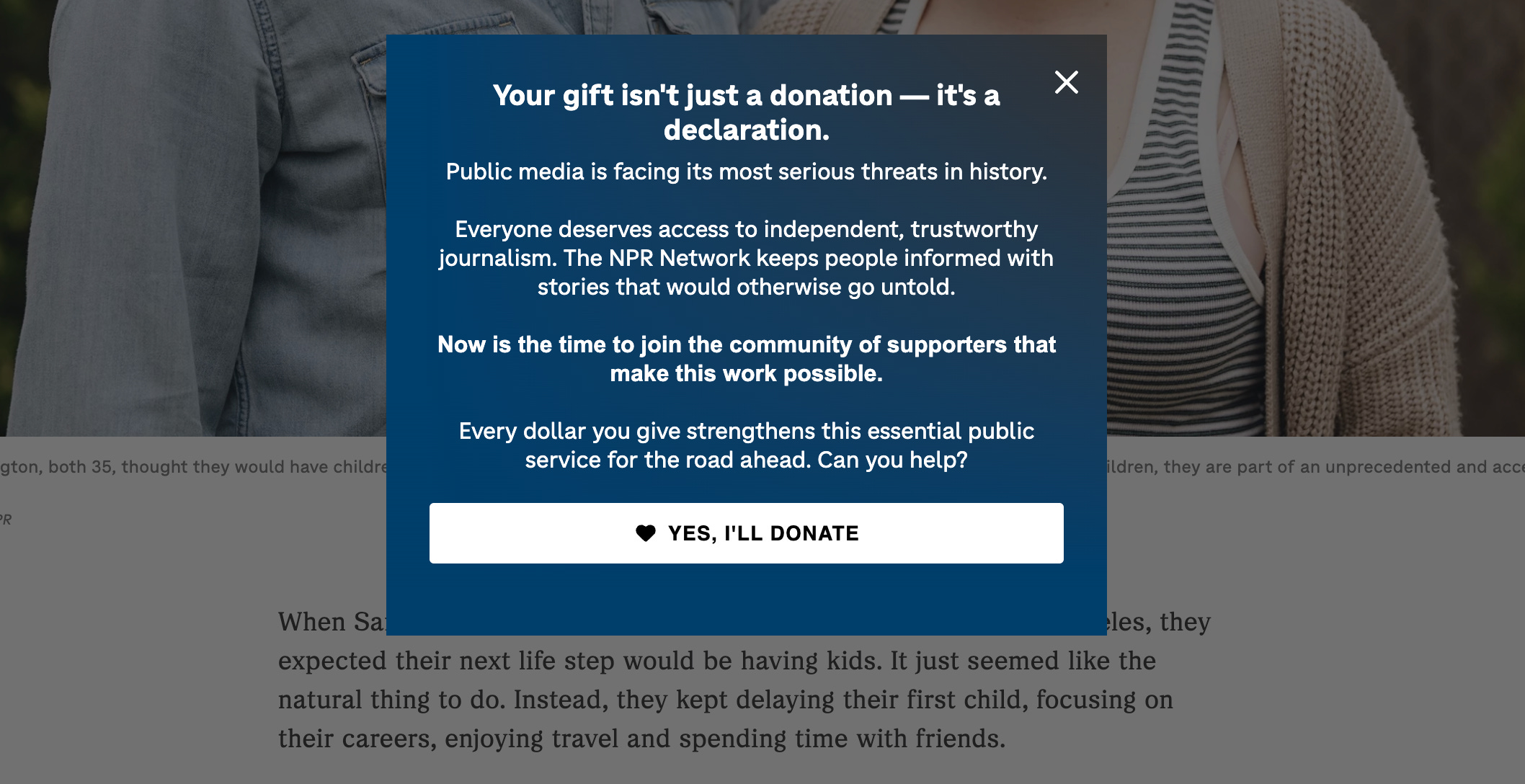
I’m no stranger to the drama that’s been unfolding between President Donald Trump and the likes of publicly funded media outlets like NPR and PBS. But for those who may be, in May, Trump issued an executive order directing the Corporation for Public Broadcasting (CPB) to cease federal funding for the networks, stating that “neither entity presents a fair, accurate or unbiased portrayal of current events to taxpaying citizens.” Additionally, on June 3, Trump formally asked Congress to defund the networks. They responded by suing the administration, claiming Trump doesn’t have the power to strip them of their funds and citing “viewpoint discrimination.”
I doubt many would disagree with the importance of having access to “independent, trustworthy journalism.” After all, a free press has been the backbone of this country; who can forget the muckrakers of the early 1900s, exposing corruption and raising public awareness of social and economic issues. This type of journalism has been a force for progress in the United States for more than a century, leading to tangible policies and regulations including the Pure Food and Drug Act (thanks to Upton Sinclair’s reporting and his book “The Jungle”) and child labor laws (based on images snapped by photojournalist Lewis Hines).
The difference — at least one of the most notable ones — between these pioneering journalists of the past and contemporary ones at NPR and PBS is federal funding. (Of note: Hines did some work for the Works Progress Administration that was unrelated to his efforts around child labor.)
Established by Congress in 1967, the CPB at the time reflected lawmakers’ concerns with commercial broadcasters prioritizing profits over public interest, as well as their belief in the importance of all Americans – regardless of income or geographic location – having access to high-quality media and information. Today, the CPB receives approximately $500 million in taxpayer funds every year to allocate to outlets like NPR and PBS, this year receiving $535 million in federal appropriations. Thus, “independent” seems to be a mischaracterization of these outlets.
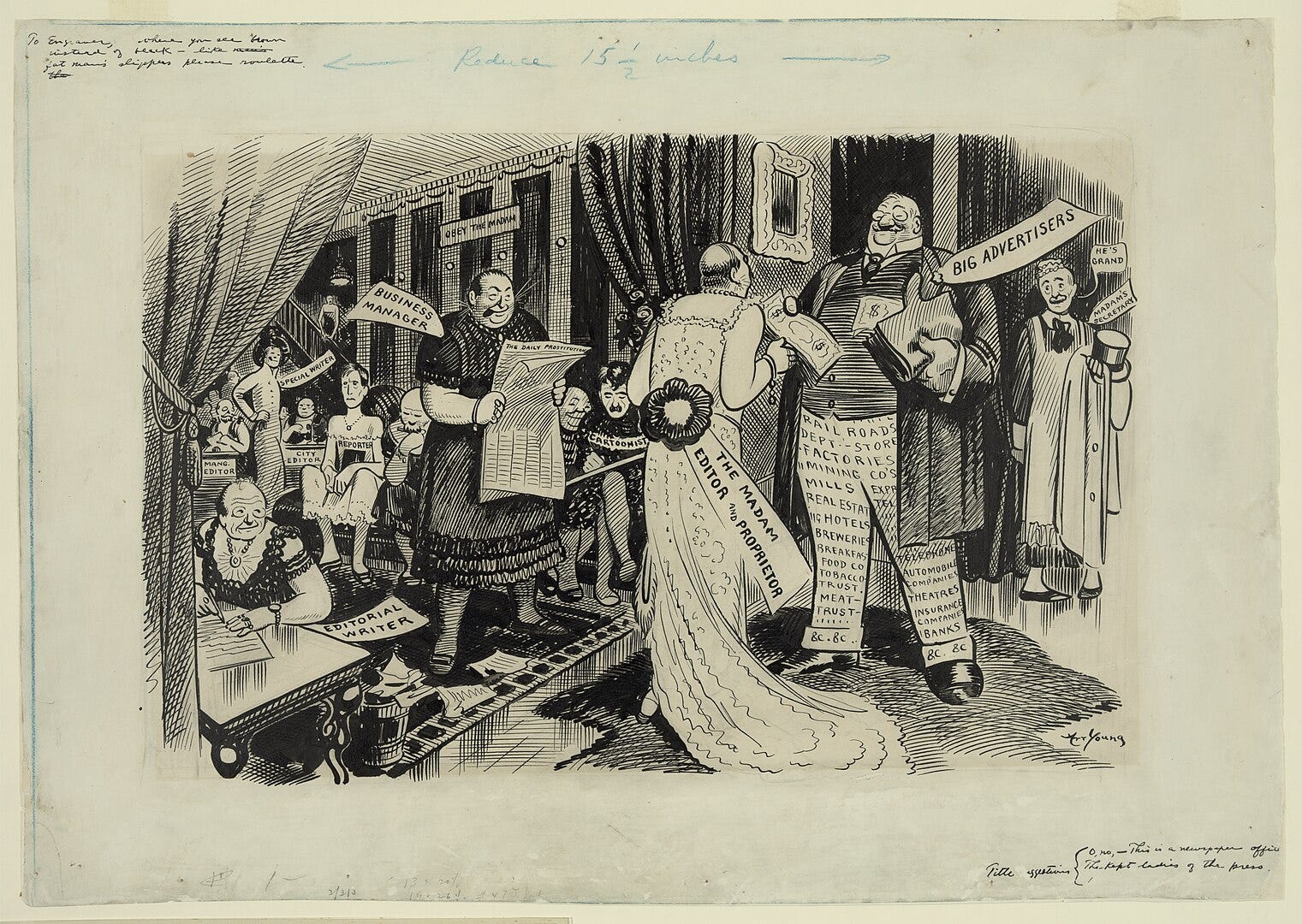
More notably, continued funding for NPR and PBS comes at a time when access to independent journalism is at an all-time high (here’s to you, fellow Substackers) and as skepticism around the motives of mainstream media — NPR and PBS included — continues to increase. This is to say nothing of the many historical examples of state-owned/run and publicly funded media being used for nefarious purposes — Nazi propaganda dehumanizing Jews and the People’s Republic of China describing Uyghur internment camps as “vocational training centers” notable examples of this.
As Jed Rubenfeld recently noted in an article published by The Free Press, “NPR and PBS aren’t entitled to your tax dollars.” Correct as he may be, the question that many — including the Trump administration — are asking may not be the right one.
Whether NPR and PBS are biased and, as such, whether taxpayers should be funding them based on this is less important perhaps than the question of whether we should fund them at all. As Trump himself stated in his May 1 executive order instructing the CPB to cease funding for these networks, “Unlike in 1967, when the CPB was established, today the media landscape is filled with abundant, diverse and innovative news options.”
Similar to the now-obsolete Farm Security Administration that helped struggling American farmers during the Great Depression and the Paycheck Protection Program that supported small business owners during the 2020 pandemic, the CPB may have served out its purpose.
Of course, we must blame someone. And for that, you can look to the Internet.
As mainstream media outlets have struggled to remain profitable in the digital era, independent journalists have thrived (thanks to podcasts and platforms like Substack and Patreon). In this new era, which now includes AI, mainstream media outlets have experimented with a variety of strategies and formats to remain relevant and profitable, albeit with minimal success.
But the point is, they’re trying … because they have to.
When your revenue, at least in part, is guaranteed by your government, this creates a perverse incentive to continue with business as usual. When you’re not forced to innovate, as NPR and PBS have not had to, you become irrelevant, antiquated, obsolete.
The Trump administration said it itself: “Which viewpoints NPR and PBS promote does not matter,” the executive order reads. “No media outlet has a constitutional right to taxpayer subsidies.”
Our “right” lies in our ability as Americans to seek out the news sources that we see fit … because, as NPR states, “everyone deserves access to independent, trustworthy journalism.” Today, there’s no shortage of those — a fact that’s rendering what was once an “essential public service” nonessential.
Ugh i miss more public funded outlets. This excessive monetization and funding cuts has ruined it for most of us, in terms of excess to intellectual sources, hence leading to a decline of intellectualism in the Third World especially. Great piece!