

Bread and circuses: The follie of government assistance
How Rome's grain dole undermined the Republic's own advancement by creating a society incapable of fending for itself.

“If you don’t depend on yourself, you will always be a slave.”
— Confucius
In the 2nd century BCE, as Rome expanded its empire through conquest, its population grew rapidly. Rural migrants and former farmers – whose land was lost to large estates worked by enslaved laborers – moved into the cities. No longer able to produce their own food, the masses in these urban centers had to rely solely on markets.
To ensure the continued availability of grain — one of the cheapest food staples at the time — and to keep the peace, the state stepped in. Grain distributions were used as a temporary means of alleviating hunger, as necessary, for impoverished citizens.
It wasn’t long, however, till those in power realized the utility of controlling this key resource.
Brothers Tiberius and Gaius Gracchus saw how feeding the hungry garnered political loyalty, thus Rome’s formal grain dole, known as the Cura Annonae, was born. The state began regularly distributing subsidized grain to approximately 200,000 adult male citizens to address food shortages and maintain social order. Augustus became the first Roman emperor to establish a lasting bureaucratic system to facilitate the Annonae.
In 58 BCE, at the urging of Publius Clodius Pulcher, the program expanded to offer free grain distributions for eligible Romans, while those who didn’t qualify faced volatile and, often, high market prices.
Thus, the Cura Annonae was no longer a stopgap solution for sustaining those in need, but an effective tool for ensuring long-term political support. (And a contentious one at that.)
People began to flock to Roman cities to take advantage of the benefit. More citizens abandoned farming as a vocation — giving up the very mechanism that made the grain dole possible. And Rome became a city that elevated consumption at the expense of production.
As long as plates were full, the people were placated. What was lost was their ability for self-reliance.
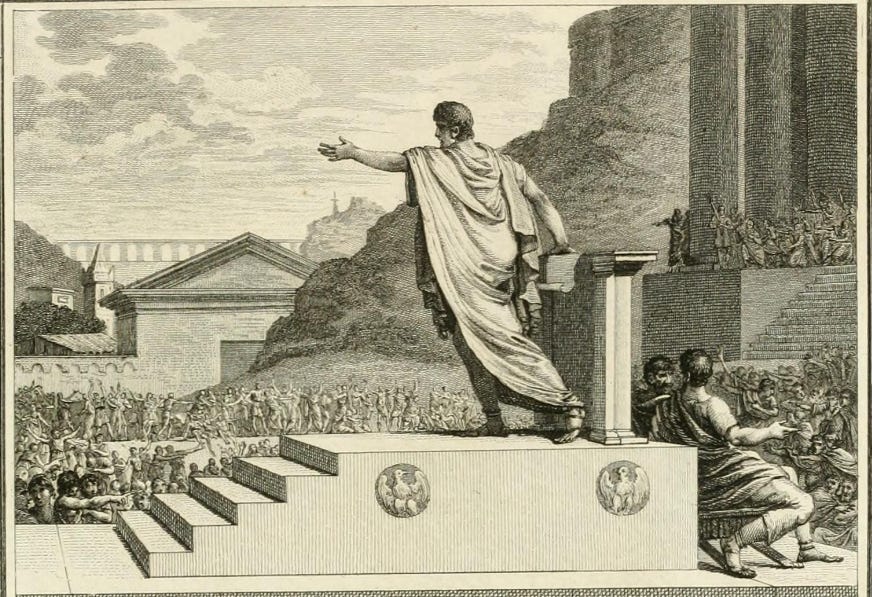
This created a political bind: As citizens’ dependence on the Annonae grew, the will of emperors to abolish it weakened. Cut it and they’d risk revolt. Thus, later emperors chose to preserve or even expand the grain dole (eventually distributing bread and other staples). It also reduced citizens’ incentive to work and contribute to society, effectively weakening the state’s economic productivity.
But the future of the Annonae was anything but guaranteed.
The one who controls language controls reality

Rhetoric, the Sophists of ancient Greece taught us, isn’t about sharing truth, but about winning arguments.
Citizens’ dependence on the state fueled Rome’s own dependency, as wheat had to be imported from other Roman provinces, including North Africa and Egypt. By the second century AD, with a population estimated at 1 million people, Rome relied on a vast and complex network of shipping routes to maintain its grain supply. This left the empire vulnerable to disruption and rebellion.
And in the 5th century, that’s exactly what happened: The Vandals seized North Africa, cutting Rome off from its most critical food source.
The repercussions were swift. No longer able to wield the Annonae as a tool to pacify the masses, and facing food shortages, the state experienced political upheaval and social unrest.
The breakdown of the Cura Annonae system contributed to the Roman empire’s instability and helped pave the way for its eventual collapse — conveying lessons to future generations about the dangers of trading self-reliance for a bit of bread.
Sources:
https://www.ancient-history-sites.com/roman/daily-life/food/annona/
https://scholarworks.harding.edu/cgi/viewcontent.cgi?article=1034&context=tenor
https://taxproject.org/cura-annonae/
https://archive.johncabot.edu/server/api/core/bitstreams/95b05c4d-d8e2-4124-a3ae-298733df5cc6/content

"If you would have them be brothers, have them build a tower. But if you would have them hate each other, throw them corn"
--Antoine de St-Exupery
A most interesting topic. The question is how manageable such processes are. It seems that if a Great System (in this case, the Roman Empire in all its vastness and complexity) has its own logic and has acquired a certain inertia, then essentially the only option is... well, perhaps to embrace stoicism. But if the phenomenon hasn't yet taken root (like the mass social welfare payments in the US, which seem to be absent right now), then some changes can still be made before the locomotive switches to other tracks. Perhaps. At least try. From my experience of Russian life, I can only add that an indigenous population dependent on the state (or those who seized it for private ownership, like the Russian tsars from Ivan to Putin) turns into sausage meat. They are no longer a COMMUNITY, not citizens. Divide and... well, you know.