

A republic, if we can keep it
In the latest essay in our "I believe" series, I examine what is required of us if we are to maintain a free and prosperous nation.

“Ask not what your country can do for you, but what you can do
for your country.”
—President John F. Kennedy
When President John F. Kennedy spoke these words during his 1961 inaugural address, the mood of the nation was one of tension and youthful optimism.
The country was divided — though not polarized — over issues like civil rights and the Cold War. Tensions with the Soviets spurred concerns among Americans about falling behind in science, technology and defense, and the possibility of nuclear war loomed large. At the same time, Americans had high confidence in the nation’s institutions (68% trusted government most of the time), strong national pride and economic optimism, as polls from that time show.
Both the sense of urgency and hope spurred by this time reinforced America’s civic-minded ethos — a widely held belief that, as citizens, Americans should serve their country, whether it be through military service or political office. On that day, in 1961, Kennedy recognized the spirit of the moment and the sense of duty felt by all Americans, that each person has a role to play in democracy’s survival.
Today’s landscape and atmosphere is much different.
As of 2025, 58% of U.S. adults say they are “extremely” (41%) or “very” (17%) proud to be an American — a 9% drop from the previous year. Trust in institutions is down as well, with just 28% of U.S. adults expressing “a great deal” or “quite a lot” of confidence in nine U.S. institutions, representing the fourth year in a row of sub-30% averages. Another poll put trust in the federal government specifically at 22% in 2024 — that is, people who trusted the government to do what is right all or most of the time — compared to 77% in 1964, three years after Kennedy’s inauguration and one year after his assassination. And while we face many real threats from abroad today, our greatest enemy is not outside of our borders but within us.
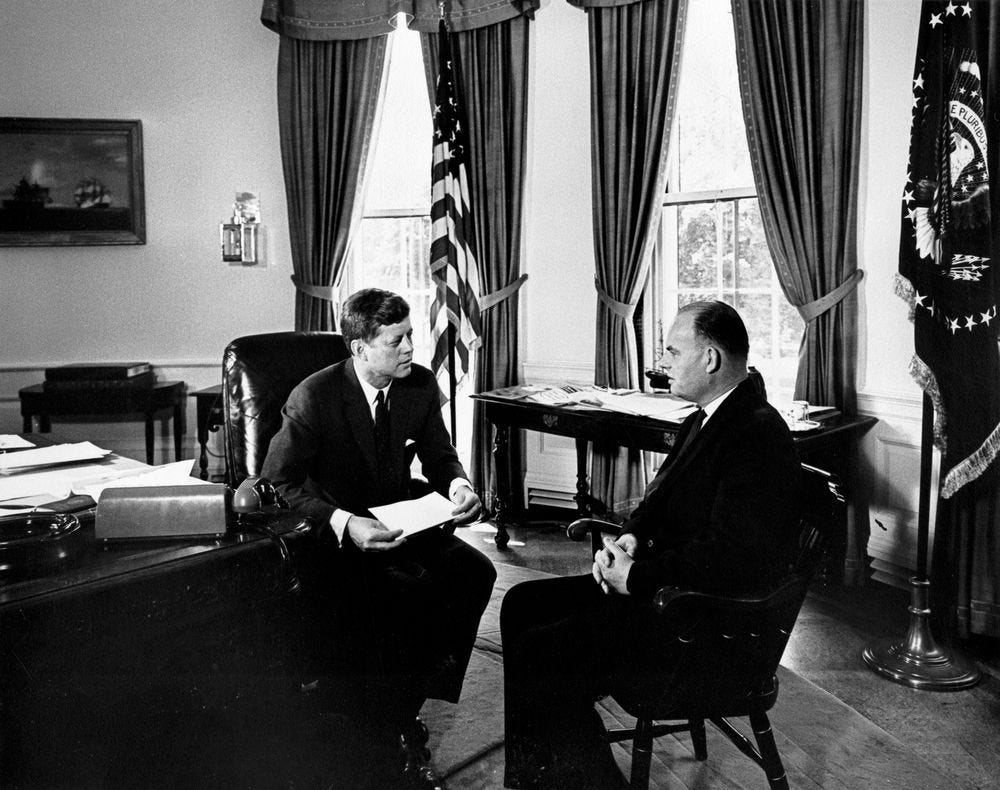
Allowing our disagreements to divide and polarize, we are at war with ourselves and with the idea of America itself. Patriotism has been traded for contempt, a sense of duty to country and community by allegiance to an ideology, and civic involvement by activism. The challenges and needs of our nation no longer serve as a rallying cry, rather as a deterrent to civic life altogether — at a time when America needs her citizens more than ever.
Our storied history and our current predicament inform my belief in the need for active engagement in our democracy. I believe that we have a duty to remain civically engaged and involved — during good times and, especially, bad. I believe it’s not just our responsibility as Americans to do so; it’s a prerequisite to an informed nation, a compassionate nation, a prosperous nation — a free nation. A nation that is capable of acknowledging and resolving its own issues.

When we neglect our civic duty, when we stop standing up for our nation’s foundational values and making our voices heard on the issues that matter most to us — at the ballot box, in public forums, at school board meetings – we’ll find ourselves with greater government, worsening problems and less control. Thus, “a government of, by and for the people” is not an idealistic mantra, but a pragmatic means for maintaining our democratic republic.
The lessons of Kennedy’s time still hold true and our modern challenges bear this out: Self-government cannot function without the active participation of its citizens. Though what this looks like for each person will vary.
In 1961, President Kennedy’s challenge to the American people was clear: Freedom requires responsibility, and democracy requires active citizens. That truth has not changed — only the shape of the challenge has. Where Americans once feared Soviet missiles, we now face the quiet threat of apathy, division and cynicism. However, the duty to remain civically engaged is the same. The only way our democratic republic will endure is if we, the people, take ownership of it.
How do you do your part to remain civically engaged in the American experiment?
“It is the first responsibility of every citizen to question authority.”
— Benjamin Franklin

Great read.
When it comes to true patriotism, to "good old America," there's no better. Admiral James Stockdale and his wife wrote "In Love and War." It's a wonderfully simple story about what keeps individuals and communities from descending into chaos and hell. Love and faith. Faith in the existence of truth, conscience, and honor. However, it seems a man who spent seven years in Vietnamese captivity, including many years in solitary confinement, hasn't told the whole story...